In the realm of high-end manufacturing, the bridge between “precise” and “ultra-precision” is defined by sub-micron tolerances and nanometer-level surface finishes. For industries ranging from aerospace optics to medical micro-fluidics, selecting the correct machining process is not just a technical choice—it is a financial and functional pivot point.
Two technologies dominate this space: Single Point Diamond Turning (SPDT) and Ultra-Precision Milling (UPM). While both utilize monocrystalline diamond tools and air-bearing spindles to achieve incredible results, they serve fundamentally different geometric and material needs.
I. Technical Deep Dive: Process Mechanics
Single Point Diamond Turning (SPDT)
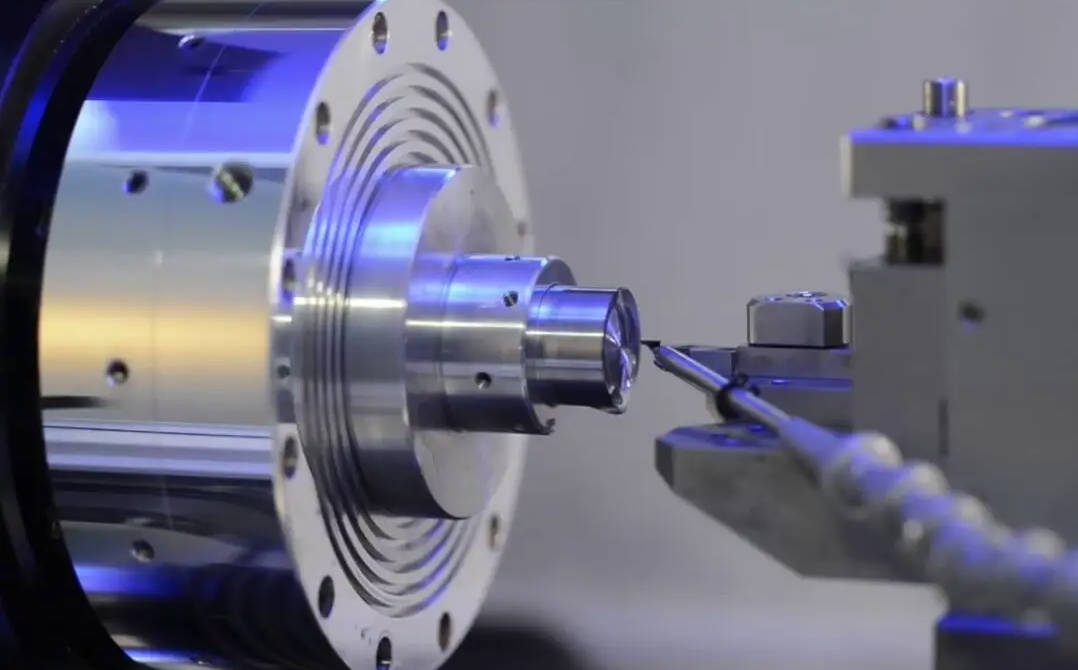
SPDT is essentially the ultimate evolution of the lathe. It relies on a high-precision, monocrystalline diamond tool to shear material at a molecular level. The workpiece rotates at high speeds on an air-bearing spindle, while the tool moves along CNC-controlled axes.
- The Tool: Uses a natural or synthetic single-crystal diamond with an edge radius often smaller than 100 nanometers.
- Kinematics: Best suited for rotationally symmetrical parts. The constant contact between the tool and the workpiece allows for an incredibly stable cutting environment.
Ultra-Precision Milling (UPM)
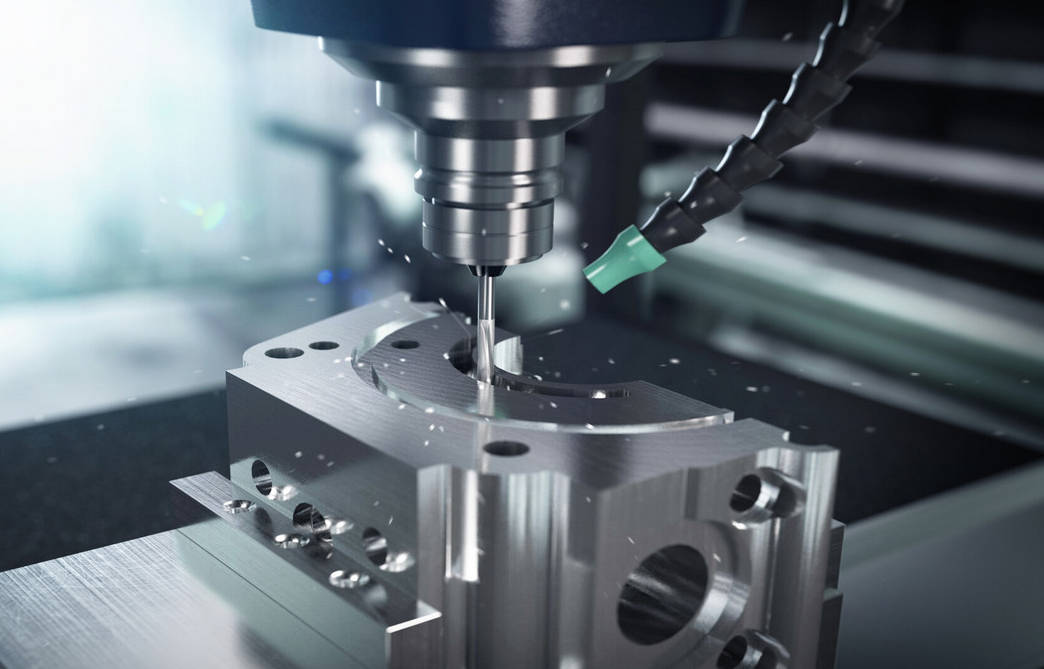
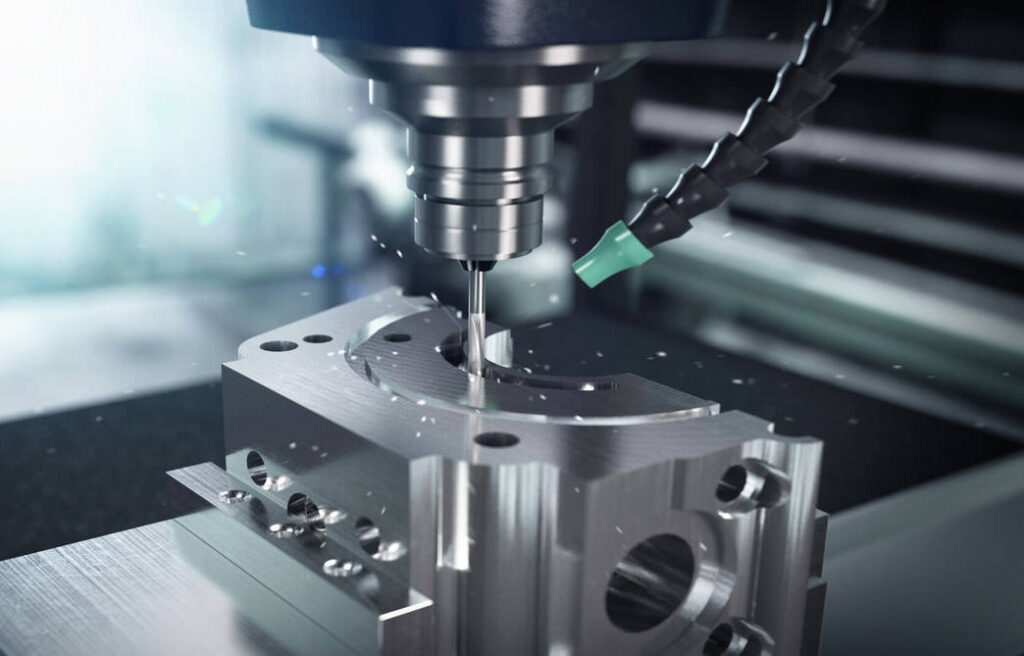
UPM (often called Micro-Milling) utilizes a rotating diamond tool rather than a rotating workpiece. This allows for multi-axis movement (3-axis to 5-axis), enabling the creation of shapes that cannot be spun on a lathe.
- The Tool: Diamond end mills or fly-cutters.
- Kinematics: The tool follows a programmed path across a stationary or multi-indexed workpiece. This process is essential for “freeform” optics—surfaces that lack a central axis of symmetry.
II. Surface Finish and Form Accuracy
When engineers discuss ultra-precision machining, the primary metric is often Surface Roughness ($R_a$).
Single Point Diamond Turning typically achieves a surface roughness ($R_a$) of less than 5 nm and a form accuracy ($P-V$) of less than 150 nm, making it the gold standard for reflective optics. Because the cutting is continuous, SPDT produces a “mirror finish” directly off the machine, often eliminating the need for manual polishing.
Ultra-Precision Milling, while highly advanced, typically produces a slightly higher roughness, often ranging from 10 nm to 50 nm $R_a$. This is due to the interrupted nature of the cut (the tool leaves the surface and re-enters with every rotation), which creates a “raster” or “cross-hatch” texture.
Comparison of Surface Characteristics
III. Material Compatibility: The “Diamond-Friendly” Factor
The chemistry between the tool and the workpiece is the most significant constraint in ultra-precision machining. Single-crystal diamond is pure carbon. At high temperatures (generated during cutting), carbon has a high affinity for iron.
The Ferrous Challenge
Diamond tools cannot directly machine ferrous metals like steel or titanium because the carbon in the diamond dissolves into the iron, leading to rapid tool failure. To circumvent this, manufacturers often use Electroless Nickel (NiP) plating. A steel mold is machined roughly, plated with Nickel, and then the Nickel layer is diamond-turned to achieve the final precision.
Optimal Materials for Each Process
- SPDT Favorites: Aluminum alloys (6061, 7075), Oxygen-free copper, Brass, Germanium (Ge), Zinc Selenide (ZnSe), and various optical polymers (PMMA, Polycarbonate).
- UPM Strengths: Beyond the “soft” metals, UPM is increasingly used for hardened steels and ceramics when equipped with Cubic Boron Nitride (CBN) tools or ultrasonic-assisted spindles.
IV. Geometry and Design Constraints
The choice between turning and milling is usually dictated by the part’s shape.
- When to Choose SPDT:
- Aspheric Lenses & Mirrors: Anything with rotational symmetry.
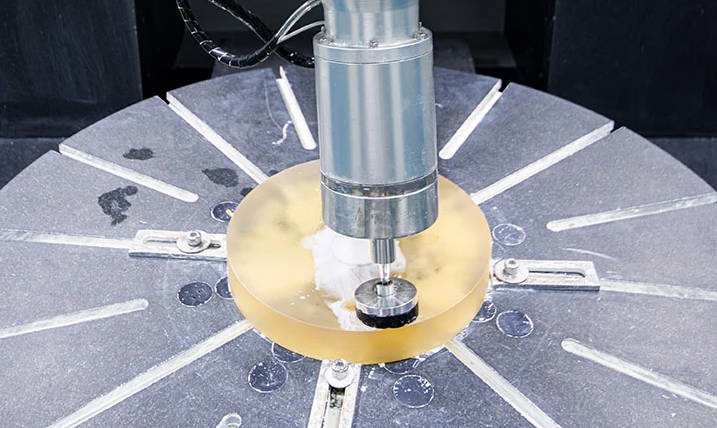
- Flat Mirrors: Using a “fly-cutting” setup where the tool is on a large disc.
- Diffractive Optical Elements (DOEs): Precision grooves for light management.
- When to Choose UPM:
- Freeform Optics: Surfaces with no axis of symmetry (e.g., progressive lenses, HUD combiners).
- Micro-Fluidic Channels: Intricate paths for medical diagnostic chips.
- Lens Arrays: Multiple small lenses on a single substrate.
V. Cost Analysis and Scalability
The cost of Ultra-Precision Machining is primarily driven by machine hourly rates and tool wear; SPDT is generally more cost-effective for symmetrical parts due to faster cycle times and longer diamond tool life compared to micro-milling.
Factor 1: Tooling Costs
A single-crystal diamond tool for SPDT can cost $500 to $2,000 but can last for hundreds of hours if used on “diamond-turnable” materials. UPM micro-end mills are fragile; a slight vibration can snap a 0.1mm tool instantly, leading to higher consumable costs.
Factor 2: Setup and Cycle Time
SPDT setups are generally faster for simple geometries. However, UPM setup is complex, often requiring sophisticated 5-axis CAM programming. For complex prismatic parts, UPM is the only option, making its higher cost a “necessary evil.”
VI. Metrology: Validating the Nanometer
You cannot machine what you cannot measure. Ultra-precision parts require specialized metrology equipment:
- Interferometry: Using light waves to measure form accuracy without touching the surface.
- Profilometry: A diamond stylus traces the surface to measure $R_a$.
- Environmental Control: These machines must sit in “Class 10,000” cleanrooms with temperature control within $\pm 0.1^\circ$C, as thermal expansion of just one degree can ruin a sub-micron part.
VII. Conclusion
For the purchaser of Ultra-Precision Machining services, the decision matrix is clear:
- If your part is rotationally symmetrical and requires a mirror finish, Diamond Turning is the superior, most cost-effective choice.
- If your design involves complex, non-symmetrical shapes or micro-features, Ultra-Precision Milling is the required technology.
By understanding these trade-offs, you can optimize your design for manufacturability, ensuring your high-performance components meet both technical specs and budgetary requirements.