You need optical lapping instead of polishing when your primary goal is to establish precise geometric form, remove significant amounts of material, or correct major surface imperfections. Lapping is a shaping process that uses coarse, loose abrasives to achieve critical specifications like flatness, parallelism, or sphericity. Polishing, in contrast, is a finishing process that uses much finer abrasives to create a smooth, specular (mirror-like) surface and remove the microscopic damage left by lapping.
Table of Contents
- What is the Fundamental Difference Between Lapping and Polishing?
- A Deeper Dive into Optical Lapping: The Art of Shaping
- Understanding Optical Polishing: The Science of Smoothness
- Lapping vs. Polishing: A Head-to-Head Comparison
- The Decisive Question: When Should You Choose Lapping Over Polishing?
- The Critical Role of Subsurface Damage
- Real-World Applications: Where Lapping and Polishing Shine
- Conclusion: A Symbiotic Relationship for Optical Perfection
What is the Fundamental Difference Between Lapping and Polishing?
Understanding the distinction between optical lapping and polishing is crucial for anyone involved in precision optics manufacturing. While both processes create smooth surfaces, they serve fundamentally different purposes and occur at different stages. Think of it like building a house: lapping is the foundation and framing, ensuring everything is level, square, and dimensionally correct. Polishing is the fine interior finishing—the smooth plaster, glossy paint, and gleaming windows that create the final, perfect appearance. One establishes the form, while the other perfects the finish.
At its core, the primary objective of lapping is to control the geometry of an optical component. It is a controlled abrasion process designed to bring a lens, mirror, or window to its required shape, thickness, flatness, or curvature with high precision. In contrast, the primary objective of polishing is to control the surface texture. It is a superfinishing process that follows lapping, designed to remove microscopic-level roughness and create a highly reflective, low-scatter surface. You lap for dimensional accuracy; you polish for optical clarity and smoothness.
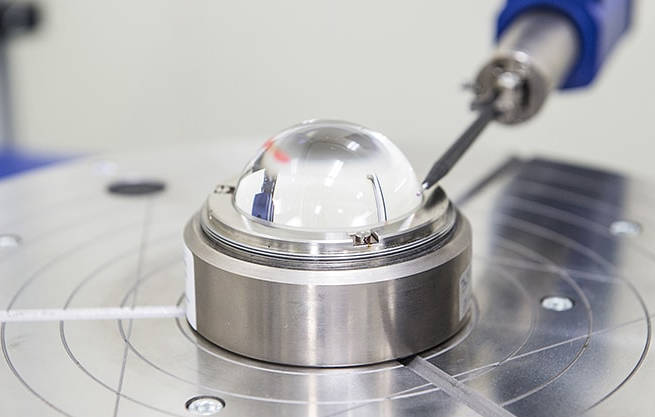
A Deeper Dive into Optical Lapping: The Art of Shaping
Optical lapping is a machining process that can be considered a form of precision grinding. It is the critical intermediate step that takes a roughly generated optical blank and refines its shape to near-perfect specifications, making the final polishing stage possible and efficient. Without proper lapping, achieving a high-quality polished optic is virtually impossible.
How Does the Lapping Process Work?
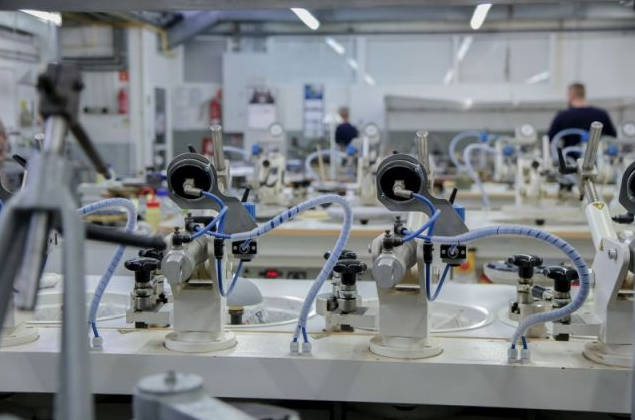
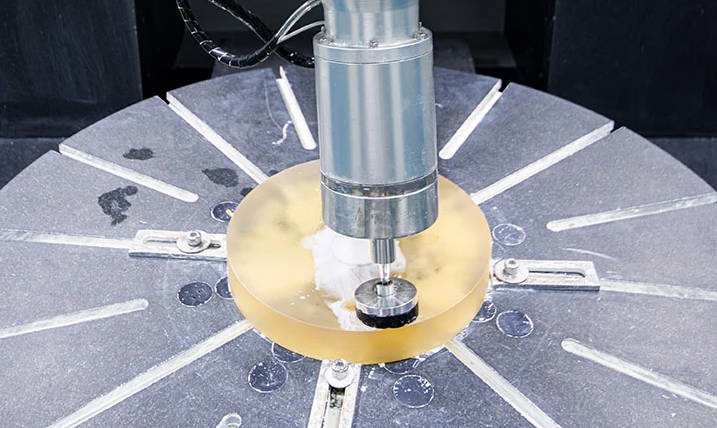
The lapping process involves sandwiching a slurry between the optical component and a precision tool called a lap. This slurry contains hard, abrasive particles (like silicon carbide or aluminum oxide) suspended in a liquid carrier (typically water or oil). The optic and the lap are moved relative to each other in a complex, often planetary, motion. The loose abrasive particles roll and slide between the two surfaces, chipping away microscopic pieces of the optical material. This action removes material in a very controlled manner, averaging out high spots and gradually conforming the optic’s surface to the shape of the lap.
The lap itself is usually made of a material that is softer than the abrasive but harder than the optic, such as cast iron or ceramic. The shape of the lap (e.g., flat, convex, or concave) is precisely what is imparted to the workpiece. For example, to create an exceptionally flat window, it is lapped against an equally flat cast iron plate. The process is governed by controlled pressure, speed, and the size of the abrasive grit, allowing an operator to systematically remove material and correct geometric errors.
What are the Primary Goals of Lapping?
Lapping is not a single-purpose operation; it accomplishes several critical tasks that are essential before polishing can even begin. Its main goals include:
- Material Removal and Shaping: Lapping is the go-to process for removing a significant amount of material efficiently, such as reducing the thickness of a wafer or window to a precise dimension. It is far more effective at bulk material removal than polishing.
- Achieving Geometric Precision: This is the hallmark of lapping. The process is used to establish extreme flatness (often measured in fractions of a wavelength of light, e.g., λ/10), precise parallelism between two faces, or a specific radius of curvature for a lens.
- Preparing for Polishing: Lapping creates a uniform, albeit frosted or matte, surface. More importantly, it removes the deep subsurface damage (cracks and stresses) introduced by earlier, rougher generating or grinding stages. It leaves behind a much shallower, more consistent layer of damage that can be effectively removed by polishing.
Common Abrasives and Tools Used in Lapping
The choice of abrasive and lap material is critical to the success of the lapping operation and depends on the optical material being worked.
- Abrasives: Graded by grit size (microns). Common types include Aluminum Oxide (Alumina), which is excellent for general-purpose lapping of glass, and Silicon Carbide, which is harder and faster-cutting, often used for harder materials like sapphire or ceramics. Diamond abrasives are used for the hardest materials.
- Laps: Cast iron is a traditional and highly stable choice for flat lapping due to its porous nature, which helps hold the slurry. Ceramic and composite laps are also used for specific applications requiring high precision and resistance to wear.
Understanding Optical Polishing: The Science of Smoothness
If lapping is about creating the perfect shape, polishing is about creating the perfect surface. It is the final, and often most delicate, step in optical manufacturing. Polishing transforms the dull, matte surface from lapping into a transparent or highly reflective one, enabling the component to perform its optical function of transmitting, reflecting, or refracting light with maximum efficiency and minimum scatter.
How is Polishing Different from Lapping?
While polishing also involves an abrasive and a tool (a polishing pad), the mechanism is fundamentally different. Polishing is a combination of mechanical abrasion and chemical-mechanical planarization (CMP). The polishing pad, made of a soft material like pitch (a tar-like substance) or polyurethane, is “charged” with a very fine polishing agent (e.g., cerium oxide). The slurry particles are orders of magnitude smaller than those used in lapping.
Instead of chipping material away, the polishing process involves a microscopic flow of material. The combination of pressure, heat from friction, and chemical reactions at the surface effectively smooths out the microscopic peaks and valleys left by lapping. The soft pad flexes and conforms to the optic’s geometry (established during lapping), allowing it to smooth the texture without significantly altering the overall shape.
What Does Polishing Accomplish?
The goals of polishing are focused entirely on surface quality and optical performance:
- Achieving a Specular Finish: The primary goal is to create a mirror-like surface that minimizes diffuse reflection (scatter) and maximizes specular reflection or transmission. This is what makes a lens transparent or a mirror reflective.
- Minimizing Surface Roughness (Ra): Polishing reduces the average surface roughness (Ra) to the angstrom level (tenths of a nanometer). This ultra-smooth surface is critical for applications like high-power lasers and precision imaging systems.
- Removing Subsurface Damage (SSD): This is a crucial function. Lapping leaves a thin layer of micro-cracks just below the surface. Polishing meticulously removes this damaged layer, which is essential for the optic’s mechanical strength and its ability to withstand high laser energy without failing.
Key Polishing Agents and Pads
The materials used in polishing are tailored for ultra-fine finishing.
- Polishing Agents: Cerium Oxide is the workhorse for polishing most types of glass. Zirconium Oxide and Aluminum Oxide are also used. For very hard materials like sapphire or silicon carbide, fine Diamond slurries are necessary.
- Polishing Pads: Pitch is the traditional material for the highest-precision optics. It is a viscoelastic solid that can be molded to perfectly match the optic’s curve and flows slowly over time to maintain that perfect fit. Polyurethane pads (like Rodel pads) are more common in high-volume production, offering good consistency and longer life.
Lapping vs. Polishing: A Head-to-Head Comparison
To clarify the choice between these two processes, a direct comparison highlights their distinct roles in the manufacturing workflow. The following table breaks down their key attributes, showing how they complement each other to produce a finished optical component.
| Attribute | Optical Lapping | Optical Polishing |
|---|---|---|
| Primary Goal | Achieve precise geometry (shape, flatness, parallelism, thickness). | Achieve superior surface finish (smoothness, clarity, low scatter). |
| Material Removal Rate | High; measured in microns per minute. | Very Low; measured in nanometers per minute. |
| Abrasive Type & Size | Hard, loose abrasives (Silicon Carbide, Alumina); 5-30 microns. | Fine, soft or hard agents (Cerium Oxide, Diamond); 0.5-3 microns. |
| Tool/Lap Material | Hard lap (Cast Iron, Ceramic). | Soft pad (Pitch, Polyurethane). |
| Mechanism | Mechanical grinding and chipping with rolling/sliding abrasives. | Chemical-Mechanical Planarization (CMP) and micro-abrasion. |
| Resulting Surface | Matte, frosted, or gray appearance; uniform but rough texture. | Specular, transparent, or highly reflective (mirror-like). |
| Key Metrics | Flatness (waves, fringes), Parallelism (arcseconds), Thickness (microns). | Surface Roughness (Ra, Rq in Angstroms), Scratch/Dig (per MIL-PRF-13830B). |
| Typical Step in Process | Preparatory step after initial generation/grinding. | Final finishing step after lapping. |
The Decisive Question: When Should You Choose Lapping Over Polishing?
The question is not a matter of choosing one *instead* of the other in a final sense, as nearly all high-quality optics are both lapped *and* polished. The operative question is, “At what stage am I, and what do I need to achieve?” You choose to perform a lapping operation when the optic’s current state does not meet the geometric prerequisites for final polishing.
Choose Lapping When: A Decision-Making Checklist
You need to perform or specify an optical lapping step when any of the following conditions are true:
- You need to correct significant form errors. If your raw optical blank has poor flatness, is wedge-shaped when it should be parallel, or is far from the target radius of curvature, lapping is the only effective way to impose the correct geometry.
- You require precise geometric specifications. When a drawing calls for flatness of λ/4 over a 100mm diameter or parallelism of less than 5 arc-seconds, these are specifications achieved through lapping. Polishing will maintain this geometry, but it cannot create it.
- You need to remove a substantial amount of material. If a window needs to be thinned from 2.5mm to 2.0mm, lapping is the method of choice. Attempting this with polishing would be extraordinarily time-consuming, expensive, and would likely ruin the part’s geometry.
- You are at the beginning of the finishing process. After a part is cut or molded, it has a rough, damaged surface. Lapping is the essential first step to remove this initial damage and establish a uniform surface ready for the final finishing stage.
- The surface has deep scratches or damage. If an optic is damaged in handling, deep scratches cannot be “buffed out” by polishing. The surface must be re-lapped to a depth below the scratch, then re-polished across the entire face to restore its integrity.
Why You Can’t Just “Polish More” to Fix a Lapping Problem
This is a common misconception among those new to optics. Polishing is not a corrective process for shape. Because a polishing pad is soft and flexible, it tends to follow the existing surface contour. If you try to polish a non-flat surface, the pad will simply ride the hills and valleys, making them smoother but not flatter. In fact, prolonged polishing on a poor shape can lead to “rolled edges” and other defects, as the edges of the optic tend to be polished away faster than the center. The rule is simple: geometry is established in lapping and preserved in polishing.
The Critical Role of Subsurface Damage
One of the most important concepts that links lapping and polishing is Subsurface Damage (SSD). It’s an invisible layer of micro-cracks and crystalline stress that exists beneath the physically visible surface of a ground or lapped optic. Managing and removing SSD is paramount for performance.
What is Subsurface Damage (SSD)?
When a hard abrasive particle from lapping or grinding impacts the surface of a brittle material like glass or sapphire, it creates a tiny fracture. This impact sends stress waves into the material, creating a network of microscopic cracks that extend below the surface. The depth of this damaged layer is directly proportional to the size of the abrasive used. Rough grinding creates deep SSD, while finer lapping creates a much shallower SSD layer. The surface may look uniform, but this hidden network of cracks is a critical point of failure.
Why Removing SSD is Essential for High-Performance Optics
The final polishing step must be substantial enough to remove the entire layer of SSD left by the final lapping stage. Failing to do so has severe consequences. For high-power laser optics, the micro-cracks in the SSD layer can absorb laser energy, leading to localized heating and catastrophic failure at power levels far below the material’s theoretical limit. For imaging optics, SSD can contribute to light scatter, reducing contrast and image quality. Furthermore, these micro-cracks compromise the mechanical strength of the component, making it more susceptible to fracturing under thermal or mechanical stress.
Real-World Applications: Where Lapping and Polishing Shine
The interplay between lapping and polishing is evident in many high-technology fields:
- Astronomical Telescope Mirrors: A large mirror blank is first lapped (or “figured”) to achieve its precise parabolic or hyperbolic shape. This can take months. Afterwards, it is polished with pitch and fine rouge to create the ultra-smooth, highly reflective surface needed to capture faint starlight without scatter.
- Laser Optics: A laser window must have extremely parallel faces to avoid distorting the beam. This parallelism is achieved through precision double-sided lapping. The surfaces are then polished to an exceptionally low roughness (often < 1 Å Ra) to minimize scatter and achieve a high laser damage threshold.
- Semiconductor Wafers: Silicon wafers must be incredibly flat and smooth for photolithography to work. They undergo extensive lapping and chemical-mechanical polishing (CMP) to achieve global and local flatness tolerances measured in nanometers.
Conclusion: A Symbiotic Relationship for Optical Perfection
In the world of precision optics, lapping and polishing are not adversaries but indispensable partners in a sequential process. The decision of when to use lapping is not a choice against polishing, but a recognition of the necessary groundwork. Lapping is the essential, geometry-defining step you perform when the shape, dimensions, and foundational surface of an optic are not yet perfect. It is the disciplined work of creating the perfect canvas.
Polishing is the final, artistic flourish that brings that canvas to life, transforming the precisely shaped but dull component into a functional, high-performance optic. By understanding the distinct roles of each—lapping for form and polishing for finish—manufacturers can efficiently and reliably produce optical components that meet the ever-increasing demands of modern technology. The right choice is always to use both, applying each process at the right time to achieve its specific, crucial goal.
optical lapping, optical polishing, lapping vs polishing, difference between lapping and polishing, when to use lapping, optical surface finishing, precision optics manufacturing, subsurface damage, surface flatness, lapping process, polishing process, chemical mechanical polishing, scratch dig