
When a protective lens has a wide field of view, high wrap, or a large optical zone, a surface can look glossy and still create distortion, glare, or unstable molding results. At Yishun Optical, we provide custom safety glasses lens mold machining that brings mirror surface quality, lens form, datums, and inspection into one practical plan.
We work from your approved drawing and help you turn a safety lens design into a mold insert that is easier to validate, replicate, and maintain.
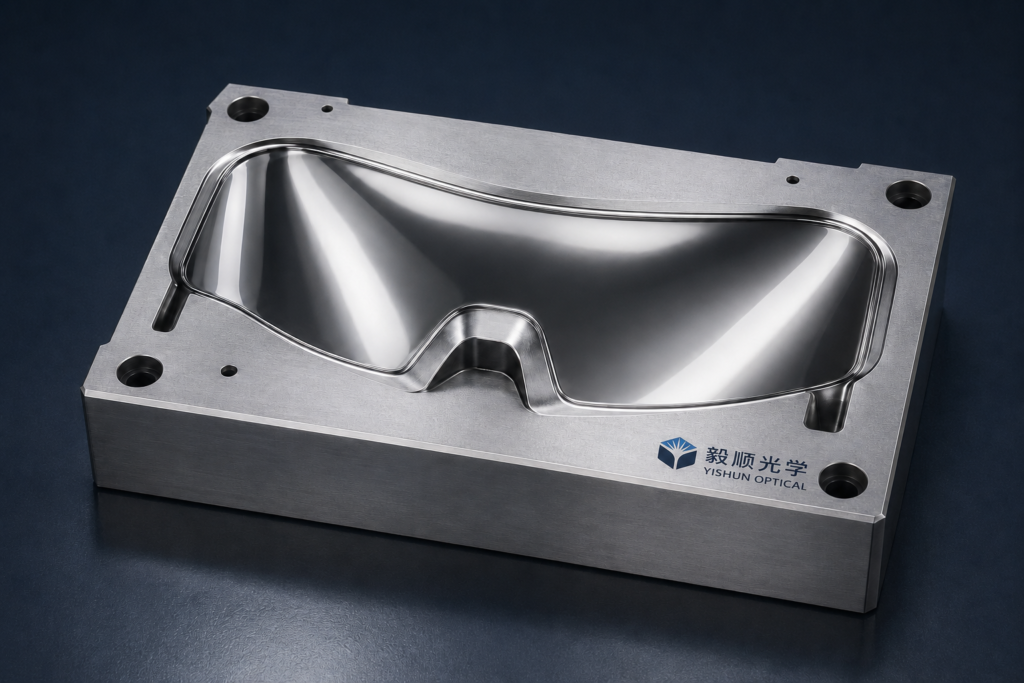
Use: An industrial safety glasses lens mold insert forms the optical and mechanical surfaces of molded safety-glasses lenses. It can support one-piece wraparound designs or separate left/right lens designs. The insert influences the replicated surface, curvature, optical zone, edge profile, thickness distribution, and assembly datums of the lens.
Product Introduction
Production process: Depending on the mold material, hardness, coating condition, lens curvature, optical aperture, and tolerance, we may use ultra-precision machining, five-axis mirror machining, precision grinding, or other controlled processes. We keep the route concise at quotation stage and confirm it only after reviewing the actual design. The target is a directly generated or carefully finished mirror surface without sacrificing the lens form.
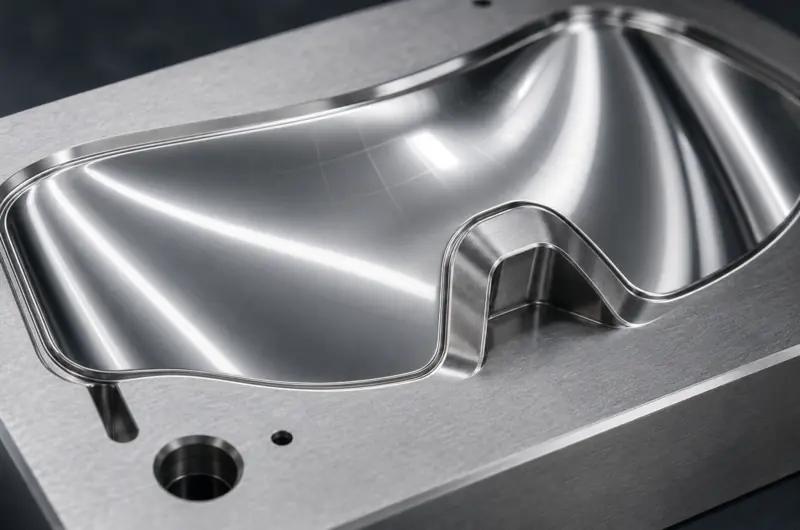
Precision standard: We manufacture to the customer-approved drawing, datum system, surface definition, and inspection plan. Important controls may include dimensional tolerance, profile or form error, surface roughness, optical-zone continuity, edge condition, and left/right or cavity-to-cavity consistency. Selected projects have reached dimensional accuracy up to ±0.001 mm, form accuracy PV 0.15 μm, and surface roughness Ra 0.005 μm under suitable conditions. These values are capabilities from selected work, not automatic limits for every geometry.
Important compliance note: We machine the mold insert; we do not certify the finished safety eyewear. Compliance with standards such as ISO 16321 or ANSI/ISEA Z87.1 depends on the final lens material, thickness, molding, coating, frame assembly, marking, and complete product testing. We can review mold-related requirements that support your validation plan.
Technical Parameters
| Service | Build-to-print custom safety glasses lens mold machining for new inserts, prototypes, replacement inserts, and matched cavity sets |
|---|---|
| Typical lens geometry | Plano, spherical, aspheric, toric, cylindrical, high-wrap, panoramic, off-axis, and selected freeform optical surfaces |
| Insert materials | Customer-specified mold steels, aluminum alloys, copper alloys, and electroless-nickel-plated substrates after material and hardness review |
| Selected dimensional accuracy | Up to ±0.001 mm on selected optical mold projects; final tolerance depends on size, form, datum, material, and measurement method |
| Selected form accuracy | PV 0.15 μm achieved on selected projects under suitable geometry and inspection conditions |
| Selected surface roughness | Ra 0.005 μm achieved on selected mirror mold projects under suitable conditions |
| Inspection options | CMM, white-light interferometry, roughness measurement, microscopy, optical scanning, and customer-agreed profile comparison |
| Drawing formats | STEP/STP, IGES/IGS, X_T, DWG/DXF, PDF, and other common engineering formats |
| Order type | Prototype, trial insert, single replacement, validation batch, matched left/right pair, or multi-cavity project |
Final capability and inspection coverage are confirmed after drawing review. We will not apply one tolerance value to every area when the optical zone, sealing edge, gate area, and assembly features have different functions.
Industrial Safety Glasses Lens Mold Insert Configurations We Can Customize
One-Piece Wraparound Inserts
Integrated industrial safety glasses lens mold inserts with a wide optical zone and continuous curvature from the center toward both sides.
Separate Left/Right Lens Inserts
Matched pairs for industrial safety glasses that require controlled handed geometry, common datums, and consistent optical behavior.
Plano and Low-Curve Inserts
Lower-curvature safety-glasses lens inserts where surface flatness, optical-zone uniformity, edge geometry, and assembly position remain critical.
High-Base-Curve Inserts
High-wrap configurations designed to extend side coverage while maintaining a smooth optical transition across the usable viewing area.
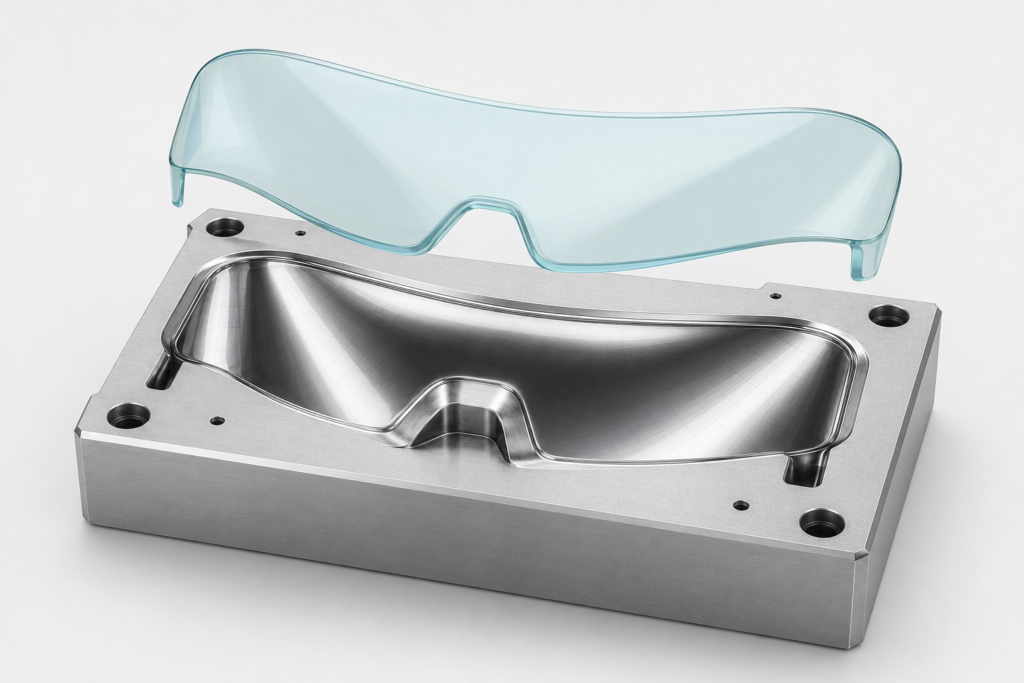
Prototype and Replacement Inserts
Single inserts for design validation, mold trials, damaged-insert replacement, maintenance, or controlled comparison with an existing insert.
Matched Multi-Cavity Insert Sets
Multiple industrial safety glasses lens mold inserts manufactured and inspected with a shared datum and comparison method to reduce cavity variation.
These are not different protective products. They are structural, curvature, and delivery options for the same product: the industrial safety glasses lens mold insert. Final specifications are always based on your approved lens design and mold requirements.
Common Problems in Safety Glasses Lens Mold Inserts and Our Solutions
Clear at the Center, Distorted at the Side
High-wrap lenses often show unwanted magnification, swim, or image bending near the side field. Small form errors become more visible across a wide optical zone.
Our solution: We confirm the optical aperture, reference datums, nominal surface, and profile comparison method before cutting. The machining and inspection plan covers center, transition, and edge zones instead of checking only one point.
The Insert Looks Bright, but the Molded Lens Shows Haze or Glare
Directional tool marks, micro-scratches, local waviness, or surface contamination can replicate into the lens and scatter light.
Our solution: We treat surface roughness, periodic marks, and visual defects as separate acceptance items. We match the process to the material and protect the optical area through cleaning, inspection, and packaging.
Left and Right Lenses Do Not Feel the Same
A mirrored CAD model does not automatically produce a matched optical pair. Datum transfer, orientation, or small profile differences can create unequal visual behavior.
Our solution: We establish a common datum logic, identify handed features, and compare the pair with the same measurement definition. This gives your team clearer data for assembly and optical validation.
Multi-Cavity Production Requires Sorting
Cavities may all pass basic size checks but still produce different optical appearance, edge fit, or coating yield.
Our solution: We use consistent setup references, process controls, and report fields across the cavity set. Cavity-to-cavity comparison helps reduce unexplained variation and repeated mold adjustment.
Optical Form Is Correct, but the Lens Does Not Assemble Correctly
If the optical surface, outside profile, bridge, sealing edge, or mounting feature uses an unclear datum, the molded part can be stressed after assembly. Stress may create visible distortion even when the free lens looks acceptable.
Our solution: We review the relationship between optical and mechanical datums. Critical edge and mounting features are included in the same acceptance plan, with one controlled datum transfer wherever practical.
Thickness and Edge Transitions Are Difficult to Stabilize
Uneven lens thickness, abrupt edge changes, or poorly coordinated front and back surfaces may affect molding balance, frame fit, and later impact testing.
Our solution: We flag thin zones, steep transitions, small radii, and areas with limited tool access during manufacturability review. We machine only to the approved design and help you identify geometry that needs confirmation before steel is committed.
Supplier and Customer Use Different Meanings for “Mirror Finish”
A visual gloss check does not define roughness, form error, scratch limits, measurement length, filter, or inspection location.
Our solution: Before production, we agree on the measurable values, visual standard, instrument, locations, and report format. This reduces arguments at final inspection and makes repeat orders easier to control.
Why Customers Choose Yishun Optical
We Find Mold Risk Before Machining
Our drawing review focuses on optical aperture, curvature, datums, edge transitions, material, hardness, and inspection access. Early questions can prevent a full rework cycle and save mold-trial time.
We Balance Form and Mirror Quality
A glossy insert is useful only when the designed lens form remains correct. We select a practical route for the surface and geometry together, helping you reduce replicated marks, distortion, and avoidable finishing risk.
We Make Acceptance Easier to Explain
We connect drawing requirements with agreed inspection records. Your engineering, sourcing, and quality teams receive a clearer basis for approval, troubleshooting, and cavity comparison.
We Support Small, Urgent, and Matched Projects
You may need one trial insert, one replacement, or a matched set rather than a complete mold. Our custom safety glasses lens mold machining service can be reviewed around the real order scope.
Real Workshop Support
Our work combines precision machining experience with hands-on process review. We do not choose a method from the product name alone. Material behavior, hardness, optical zone, curvature, feature access, and the way you will measure the insert all influence the final route.
This helps us give you a more useful answer at quotation stage: what is feasible, where the main risk is, what must be measured, and which requirements still need to be confirmed.
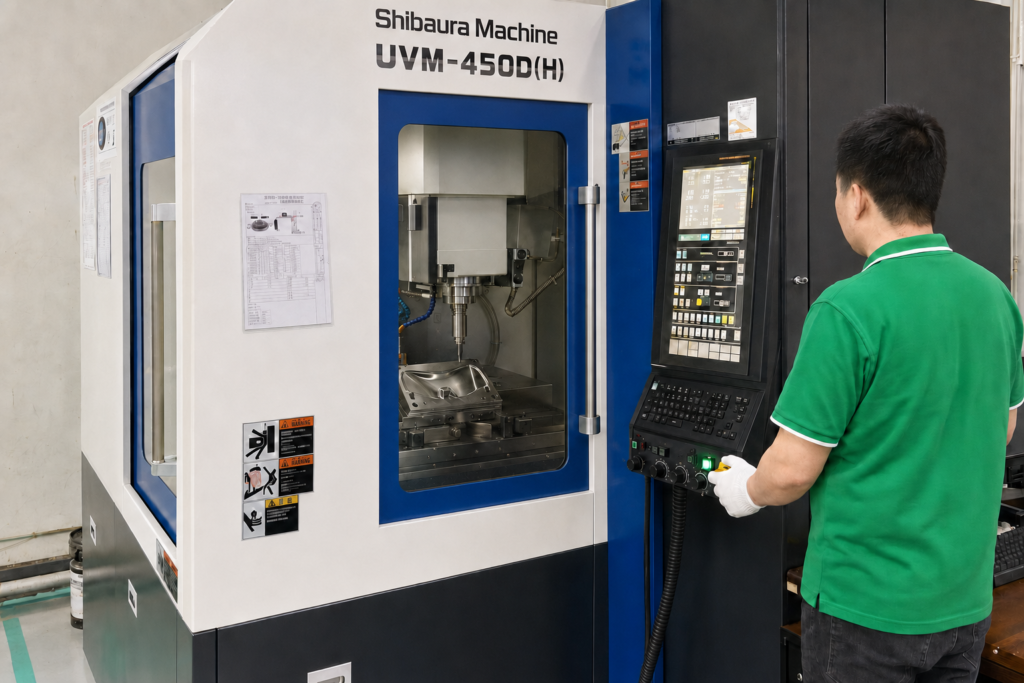
Inspection and Process Control
Inspection may include overall size and datum relationships, surface profile, form deviation, roughness, local defects, edge condition, and cavity comparison. The exact method must suit the surface and the required result. For example, a CMM can support dimensional and datum checks, while white-light interferometry and microscopy can reveal different aspects of the optical surface. We agree on the method before machining so the report answers the question your team actually needs to approve.
Order Process
01Drawing & Requirement Review
▶
02Feasibility & Quotation
▶
03Precision Machining
▶
04Agreed Inspection
▶
05Protected Packaging & Delivery
To quote efficiently, please send the 2D drawing and 3D model, insert material and hardness, optical aperture, surface definition, critical dimensions, target roughness and form, inspection method, quantity, and delivery target. If available, also tell us the lens resin, molding method, coating route, current defect, and the finished-product test you are trying to pass.
FAQ
Can you guarantee that the finished glasses will pass ANSI/ISEA Z87.1 or ISO 16321?
No supplier should make that promise from the mold insert alone. We can control the agreed insert geometry and surface, but final compliance depends on the resin, lens thickness, molding conditions, coating, frame, assembly, and complete product testing.
Can you machine high-wrap and panoramic safety lenses?
Yes, after we review the aperture, curvature, size, tool access, material, datum strategy, and inspection method. High-wrap surfaces usually need more attention at the side field and transition zones.
Do all inserts use the same mirror-machining process?
No. The suitable process depends on material, hardness, plating, form, and tolerance. We may use ultra-precision machining, five-axis mirror machining, precision grinding, or a controlled combined route.
Can the insert be machined directly to a mirror surface?
For suitable materials and geometry, a directly generated mirror surface may be possible. We confirm this after review because “mirror” must include both surface quality and retained form, not visual brightness alone.
Can you make only one prototype or replacement insert?
Yes. We evaluate prototypes, trial cavities, damaged-insert replacements, matched left/right pairs, and multi-cavity sets. Please provide the original data and any inspection record from the existing insert.
What should be written on the drawing?
Define optical and mechanical datums, optical aperture, surface profile, critical dimensions, roughness, form or profile tolerance, edge condition, visual defect criteria, and measurement method. If something is unclear, we will list it during review.
Does the mold insert create anti-fog or scratch-resistant performance?
No. We machine the industrial safety glasses lens mold insert. Anti-fog behavior and scratch resistance are mainly controlled by the lens material, molding condition, and later coating system. We control the agreed mold geometry and surface but do not claim those finished-lens functions.
How do I get a quotation?
Send your drawing, material, target precision, inspection needs, quantity, and schedule. Photos of the current defect or molded sample are also helpful. We will review feasibility and reply with the key technical questions.
About Yishun Optical
We focus on high-precision optical mold and mirror-surface machining. When you work with us, our job is not only to machine a shiny surface. We help you clarify the drawing, select a feasible route, control the optical and mechanical relationship, and prepare inspection evidence that your team can use. That is the practical value behind our custom safety glasses lens mold machining service.
Let’s Review Your Safety Lens Mold Insert
Send us your 2D/3D data and the problem you need to solve. We will review the optical zone, material, precision, inspection, and order scope before recommending a manufacturing route.