You sent the drawing several days ago, but instead of receiving a quotation, you keep getting more questions.
What material is it?
Which surface is the optical area?
Do you have a 2D drawing?
What surface roughness do you need?
How will the part be inspected?
For customers sourcing ultra-precision mold inserts or optical components, this can be frustrating. You may be comparing suppliers, preparing a project budget or trying to keep a prototype schedule moving. Every extra day spent going back and forth delays the next decision.
We see this situation quite often.
But the bigger problem is not simply waiting longer for a quotation.
The real risk is receiving a price before the machining requirements have actually been understood.
Why an Incomplete RFQ Can Cause Bigger Problems Later
Imagine sending the same 3D model to three suppliers.
One assumes the mirror area needs polishing.
Another assumes it can be directly mirror-machined.
A third supplier does not realize that one freeform surface is the critical optical area.
All three may give you a quotation.
But they are not really quoting the same job.
This is one reason prices for ultra-precision machining can sometimes vary so much.
A lower price may not mean a more competitive process. It may simply mean that fewer technical requirements have been considered.
Those missing details may return later as:
- Additional charges
- Longer lead times
- Changes to the machining process
- Difficulty meeting the drawing
- Surface quality disputes
- Parts that meet dimensions but still fail the actual optical requirement
That is why, at Yishun Optical, we prefer to clarify important technical questions before finalizing the quotation.
“I Already Sent the 3D Model. Why Isn’t That Enough?”
This is a reasonable question.
A 3D model tells us a lot about the part. We can see the geometry, cavity depth, freeform surfaces, transitions and many machining features.
But it normally does not tell us clearly which areas are functionally critical.
For example, a smooth curved surface could be:
a functional optical surface,
a cosmetic mirror surface,
a mounting surface,
or simply a non-critical machined area.
Those surfaces may look similar in CAD, but they do not require the same manufacturing strategy.
The same applies to “mirror finish.”
Does the surface only need to look bright?
Does it need to reflect light accurately?
Will it form a transparent optical area after molding?
Is there a defined roughness or form requirement?
Can the area be polished, or would polishing round an edge or change a microstructure?
These details directly influence how we machine the insert.
Why the Questions Often Arrive One at a Time
This is where customers become especially frustrated.
Today the supplier asks for the material.
Tomorrow they ask about the optical surface.
Two days later, another engineer asks about inspection.
A quotation that should have taken a few days suddenly turns into a week of emails.
We try to avoid that.
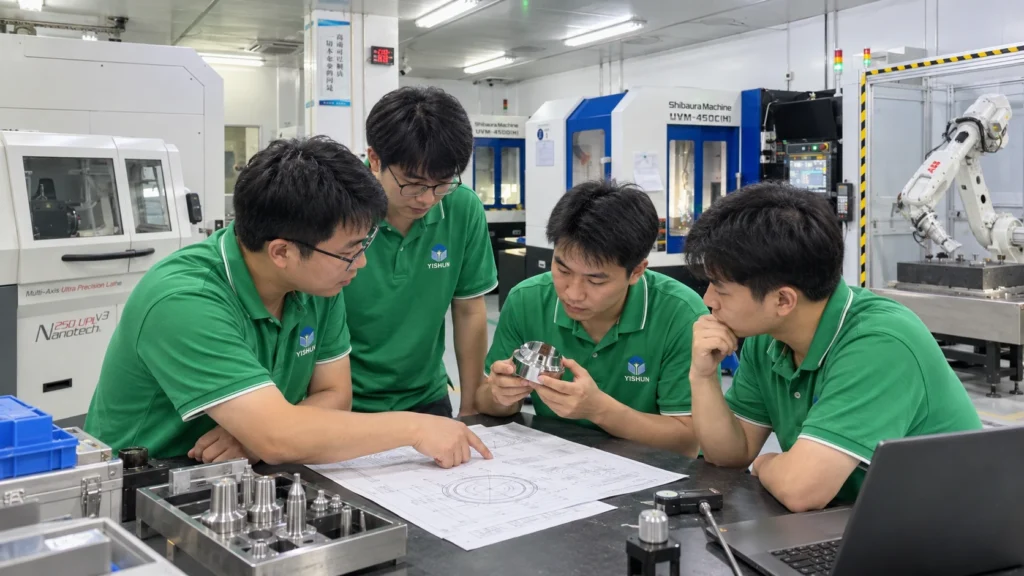
When we receive a new RFQ at Yishun Optical, our preferred approach is to review the project as a complete machining problem first.
We look at the geometry, material, critical surfaces, tolerances, machining accessibility, finishing requirements and inspection requirements together.
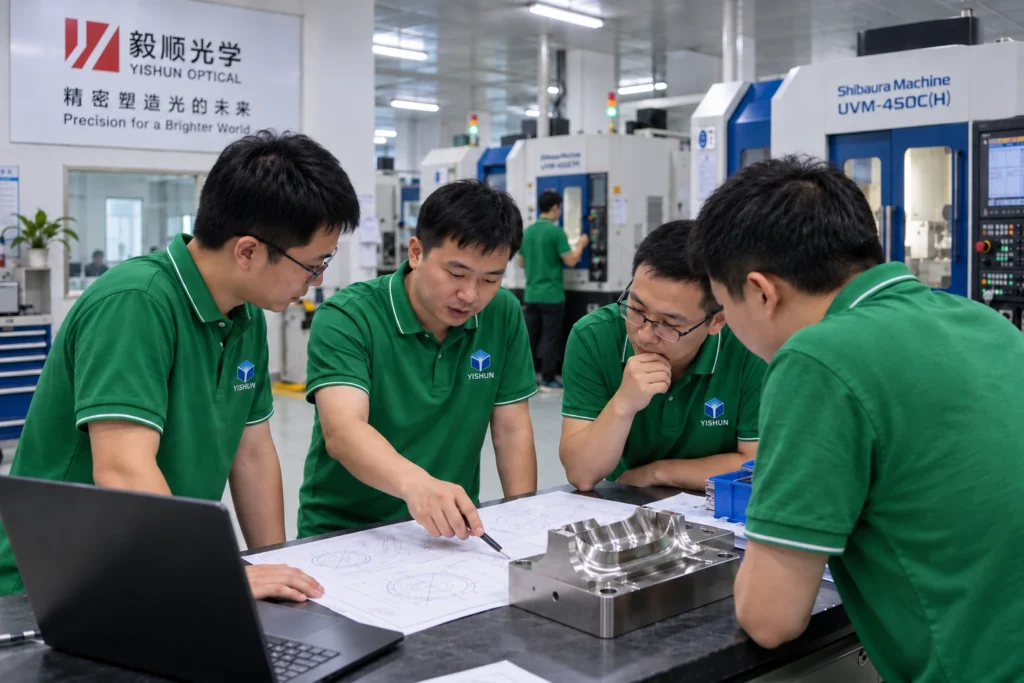
The goal is simple:
identify the important unknowns in one technical review instead of asking the customer for information repeatedly.
What We Actually Look at Before Quoting
Before deciding on the machining route, our engineers normally want to understand several things.
First, which surfaces really matter?
Not every area needs optical-level control. If we know where the functional optical surface is, we can concentrate machining and inspection effort where it creates real value.
Second, what is the exact material condition?
“Steel” alone may not be enough. Grade, hardness, heat treatment and plating condition can change the suitable process.
For suitable non-ferrous materials and electroless-nickel-plated substrates, single-point diamond turning may be considered.
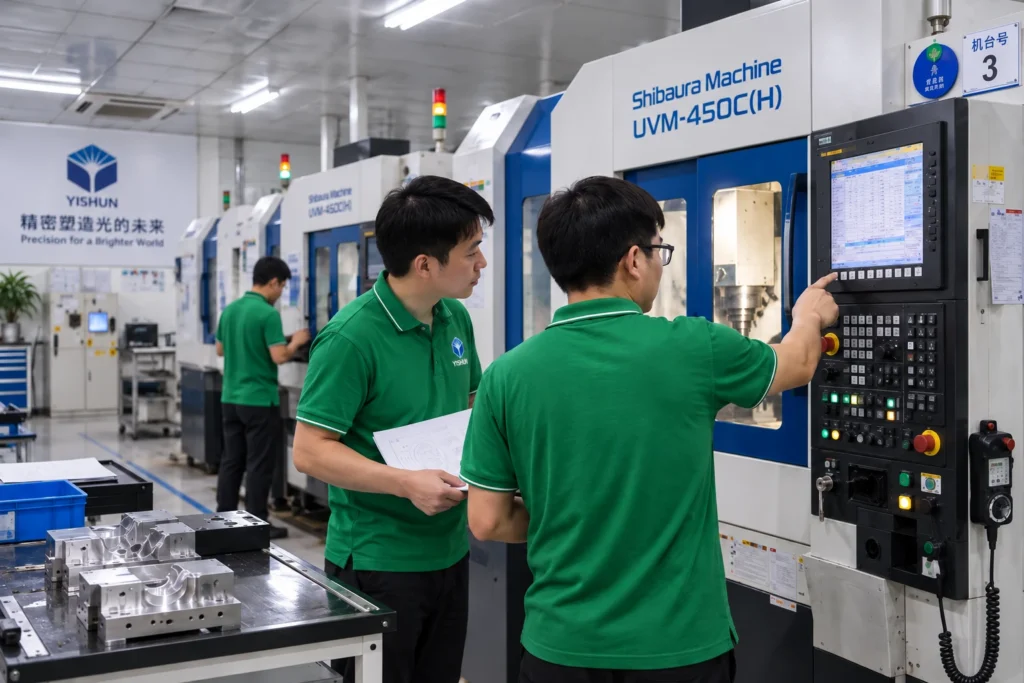
For steel mold inserts, we may need ultra-precision milling, five-axis mirror machining or another finishing route.
Third, can the tool actually reach the required geometry?
A part may look completely machinable on screen, but a deep cavity, steep wall or restricted tool angle can become the real limitation.
We have encountered projects where the biggest problem was not tolerance at all. The sidewall was simply too deep for the intended tool to reach safely.
That needs to be discovered before machining starts, not afterward.
Surface Requirements Need More Than the Words “Mirror Finish”
Another common source of quotation problems is an unclear surface requirement.
For us, “mirror finish” is not a complete technical definition.
A visually bright surface is not necessarily the same as a functional optical surface.
Sometimes polishing is appropriate.
Sometimes it creates additional risk.
If polishing is not properly controlled, it may round sharp edges, reduce local depth, alter angles or damage microstructures.
For some products, our preferred approach is to achieve the required mirror surface directly through ultra-precision machining without relying on heavy polishing afterward.
That is why we need to understand what the surface is expected to do, not simply how it should look.
How We Reduce RFQ Delays at Yishun Optical
We do not expect every customer to prepare a perfect technical package before contacting us.
Many prototype projects are still being developed when we first receive them.
What helps most is having the key information together:
- Latest 2D drawing and 3D model
- Material grade and condition
- Clearly identified optical or mirror-finished areas
- Critical dimensions and tolerances
- Surface requirements
- Inspection or acceptance requirements
- Quantity and project stage
If something is missing, we first identify whether it actually affects the quotation.
Some missing details are minor.
Others completely change the machining process.
Separating those two situations helps us avoid wasting the customer’s time.
A Fast Price Is Not Always a Reliable Quote
We understand why customers want prices quickly.
Procurement needs budgets, engineers need supplier comparisons, and project managers need schedules.
But for difficult ultra-precision components, quotation speed should not come at the cost of technical understanding.
If an important requirement is unclear, we would rather discuss it before giving a final price than discover halfway through machining that both sides were working with different assumptions.
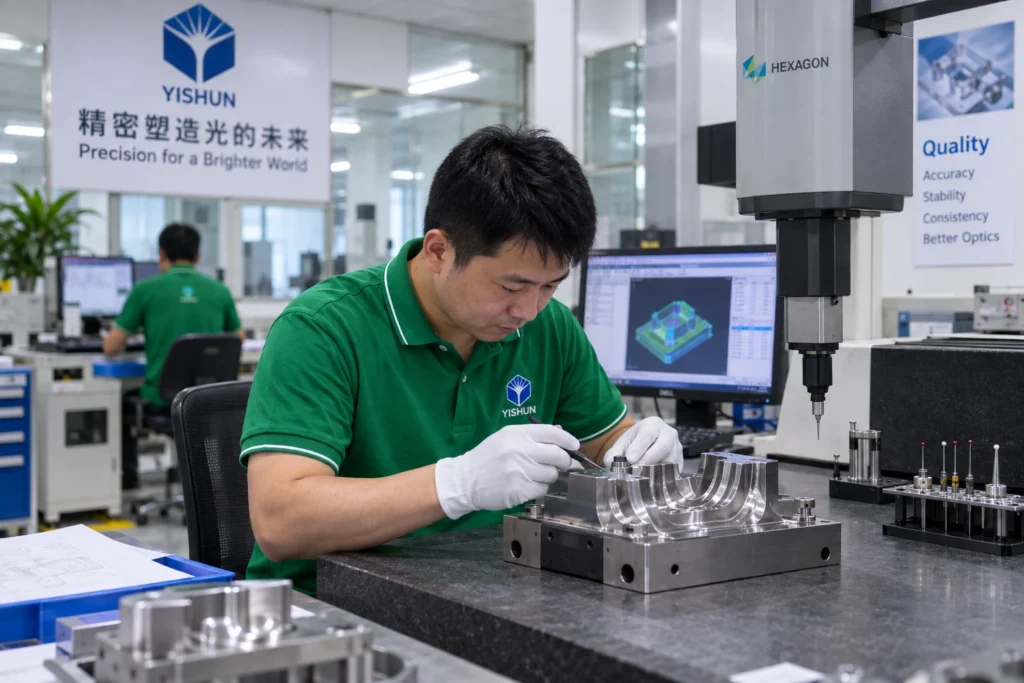
For us, a useful quotation should answer more than:
“How much does this part cost?”
It should also establish:
“Are we both talking about the same part, the same requirements and the same expected result?”
If your current ultra-precision machining RFQ has already been going back and forth for several days, send the latest drawing, 3D model, material information and your most important surface requirements together.
At Yishun Optical, we can first review the project from the machining side and identify what is still preventing a reliable quotation.
That usually saves much more time than continuing to answer technical questions one email at a time.