The LED Revolution in Automotive Lighting Is Reshaping Mold Requirements
The automotive lighting industry has undergone a fundamental transformation over the past decade. LED technology has moved from a premium differentiator to a standard specification, and the latest generation of lighting systems demands optical components that push manufacturing to its absolute limits.
Matrix LED headlights represent one of the most significant advances. Unlike conventional reflector-based systems, matrix headlights use arrays of individually controllable LED elements to create adaptive beam patterns that respond to traffic conditions, weather, and road geometry in real time. Each LED element requires its own precision lens, and these lenses must deliver uniform light distribution without hot spots, scattering, or chromatic aberration. Achieving this level of optical performance starts with the mold.
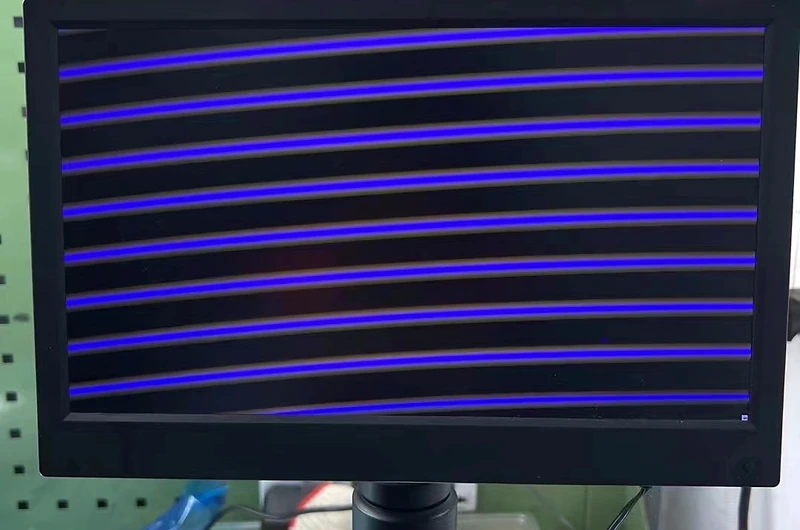
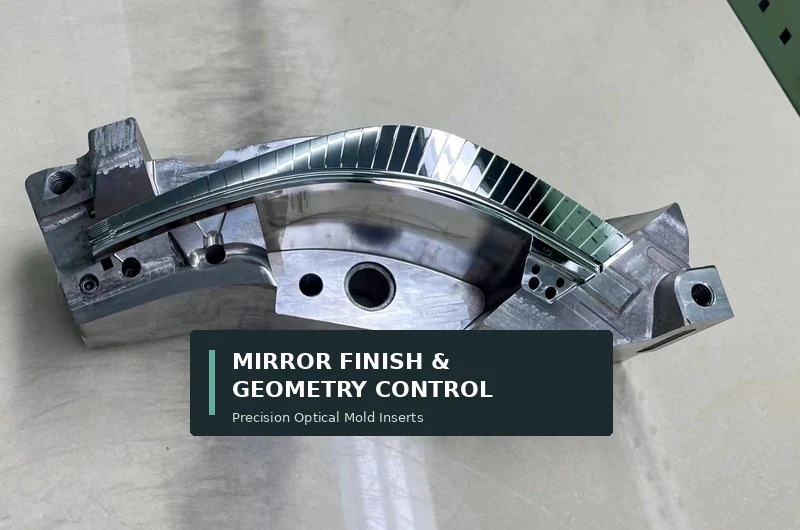
Through-type taillights — the continuous light bars now seen across premium vehicle models — introduce another set of challenges. Their elongated, often curved geometries demand mold cores with complex freeform surfaces that maintain consistent optical properties across the entire light guide length. Even minor surface irregularities become visible as bright or dark bands in the finished lens, making the mold’s surface quality a direct determinant of the final product’s visual and functional quality.
These trends have elevated optical mold machining from a specialized niche to a critical capability in automotive supply chains. Automotive OEMs and Tier-1 suppliers now require mold manufacturers that can deliver mirror-grade surfaces on complex three-dimensional geometries, hold tight dimensional tolerances across temperature variations, and do so consistently across production runs. Yishun Optical has positioned itself at the center of this shift, building its capabilities around the specific demands of automotive optical molds.
For optical engineers and procurement leaders evaluating potential partners, the key question is no longer whether a supplier can produce LED lens molds — but whether they can do so at the precision, consistency, and scale that modern automotive programs demand.
What Makes LED Headlight Lens Molds So Technically Demanding
An LED headlight lens is not a simple plano-convex element. It is a compound optical component that must simultaneously collimate, distribute, and homogenize light from one or more LED sources while meeting stringent regulatory requirements for beam pattern, glare, and color uniformity. The mold that forms this lens inherits all of these requirements and adds the additional constraints of manufacturability and durability.
The surface quality requirement is the most unforgiving specification. LED headlight lens molds must achieve a mirror-grade surface finish — typically Ra≤0.005μm — because any surface texture on the mold cavity is faithfully reproduced on every molded lens. At this level of smoothness, even sub-micron tool marks or polishing artifacts cause measurable light scattering, which manifests as haze or reduced contrast in the headlight’s beam pattern. This is where ultra-precision mirror machining becomes essential: the process must produce surfaces that are functionally indistinguishable from polished optical glass, directly from the machining center.
Surface form accuracy is equally critical. The mold cavity must match the designed optical surface within PV≤λ/4 (typically measured at 632.8 nm He-Ne wavelength). This means the peak-to-valley deviation across the entire optical surface must not exceed approximately 158 nm. For freeform surfaces used in matrix LED lenses and projector optics, this tolerance must be maintained across continuously varying curvature — a requirement that eliminates most conventional machining approaches.
Dimensional accuracy ties everything together. The mold core and cavity must be held to ±0.005mm across critical features, including locating surfaces, ejector pin positions, and parting line geometry. When a matrix headlight assembly contains dozens of individual lens cavities, cumulative dimensional errors across the mold can cause assembly fit issues and optical misalignment that degrades the beam pattern.
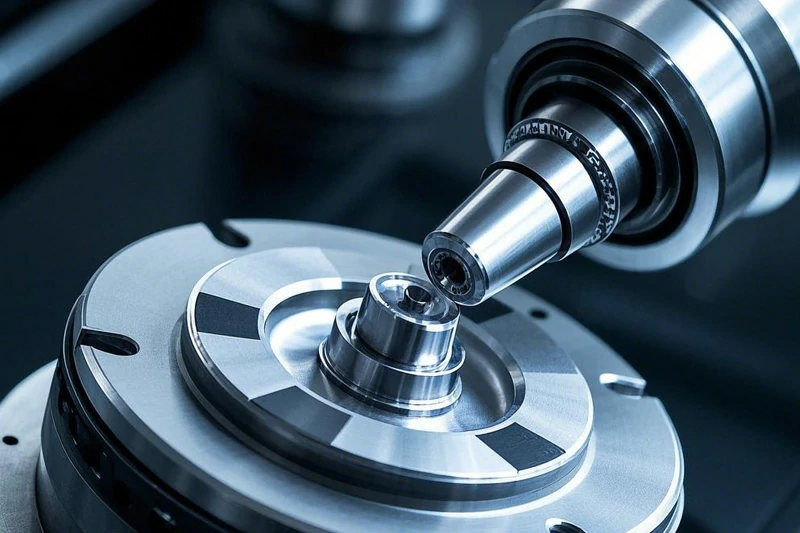
Yishun Optical addresses these challenges through a tightly integrated workflow that combines advanced machining equipment, proprietary process development, and rigorous in-process metrology. The Moore Nanotechnology 350FG diamond turning center handles the core freeform surface generation, producing the complex non-rotationally-symmetric geometries required by modern LED lens designs with nanometer-level form accuracy. The Toshiba TTV450E-AX five-axis machining center provides the flexibility to machine mold base features, cooling channels, and secondary surfaces while maintaining the positional accuracy needed for multi-cavity mold configurations.
What distinguishes Yishun Optical’s approach is the integration of optical mold core customization directly into the machining workflow. Rather than treating mold fabrication as a sequence of separate operations — roughing, semi-finishing, finishing, polishing — Yishun Optical’s process engineers develop customized tool paths, cutting parameters, and compensation strategies for each specific lens geometry. This means that the machining process is optimized for the particular surface characteristics of each mold, rather than relying on generic parameters that may leave residual errors requiring extensive hand correction.
Yishun Optical’s Manufacturing Capabilities for Automotive Light Molds
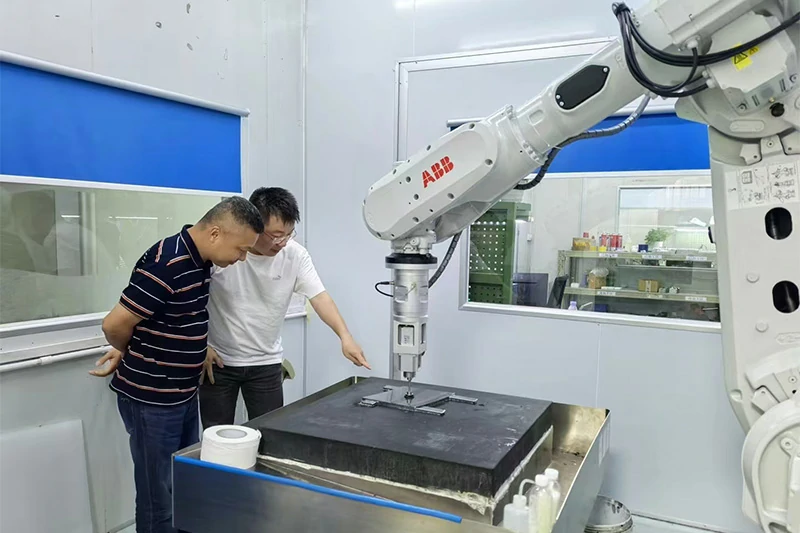
Yishun Optical’s facility in Shenzhen combines world-class equipment with deep process expertise to deliver automotive optical molds that meet the most demanding specifications in the industry. The capabilities span the entire mold manufacturing workflow, from initial optical design consultation through final mold validation and production support.
Freeform Surface Generation
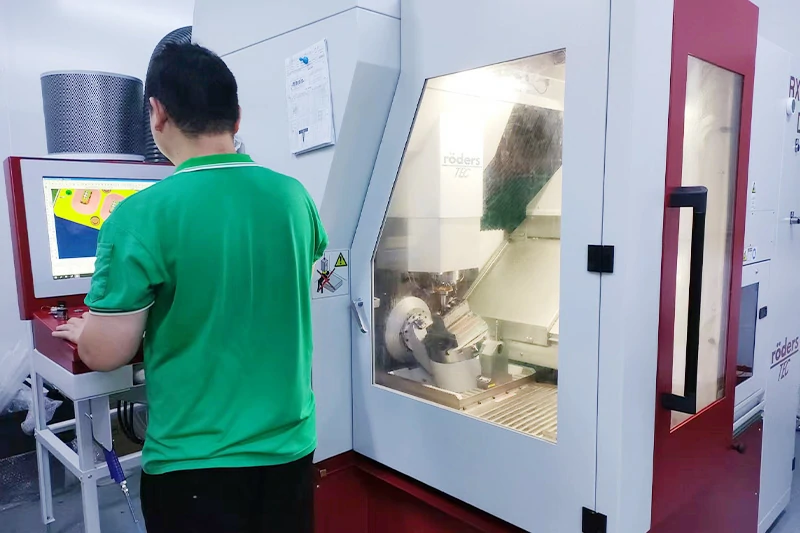
The foundation of Yishun Optical’s automotive mold capability is the Moore Nanotechnology 350FG, a purpose-built ultra-precision machining center designed for the most demanding optical fabrication tasks. This equipment generates complex freeform surfaces — including those found in matrix LED lens arrays, projector lenses, and light guide plates — with surface finishes that routinely achieve Ra≤0.005μm directly from the cutting process. The 350FG’s nanometric positioning accuracy and thermal stability allow Yishun Optical to hold PV≤λ/4 form accuracy on surfaces with feature sizes ranging from sub-millimeter micro-structures to full lens apertures.
For automotive programs that require multiple lens elements within a single headlight assembly, the 350FG’s repeatability becomes especially valuable. Each cavity in a multi-cavity mold must produce optically identical lenses, and the machine’s consistent performance across long machining runs ensures that cavity-to-cavity variation stays within acceptable limits. This reduces the need for individual cavity matching and significantly shortens mold development timelines.
Five-Axis Mold Base Machining
While the optical surfaces demand ultra-precision diamond turning, the mold as a whole requires high-accuracy five-axis machining for base plates, locating features, cooling circuits, and ejection systems. Yishun Optical’s Toshiba TTV450E-AX five-axis machining center handles these operations with the precision needed to ensure that optical cores seat correctly, cooling is uniform across the mold, and the finished mold integrates seamlessly into the customer’s injection molding press.
The TTV450E-AX’s rigid construction and thermal compensation systems allow Yishun Optical to hold ±0.005mm dimensional tolerances on complex mold base geometries, even during extended machining cycles. This capability is particularly important for large-format molds used in through-type taillight applications, where the mold may exceed 600mm in length and thermal growth during machining can introduce significant errors on less capable equipment.
Precision Mold Polishing and Surface Refinement
Even with ultra-precision machining, certain mold features require supplementary precision mold polishing to meet the final surface quality specification. Yishun Optical’s polishing team works directly from machining data to target only the areas that require refinement, avoiding unnecessary rework that could degrade form accuracy. This targeted approach — guided by metrology data from the Mitutoyo Crysta-Apex S500 coordinate measuring machine — ensures that surface finish improvements do not come at the expense of form accuracy.
In-Process Metrology and Validation
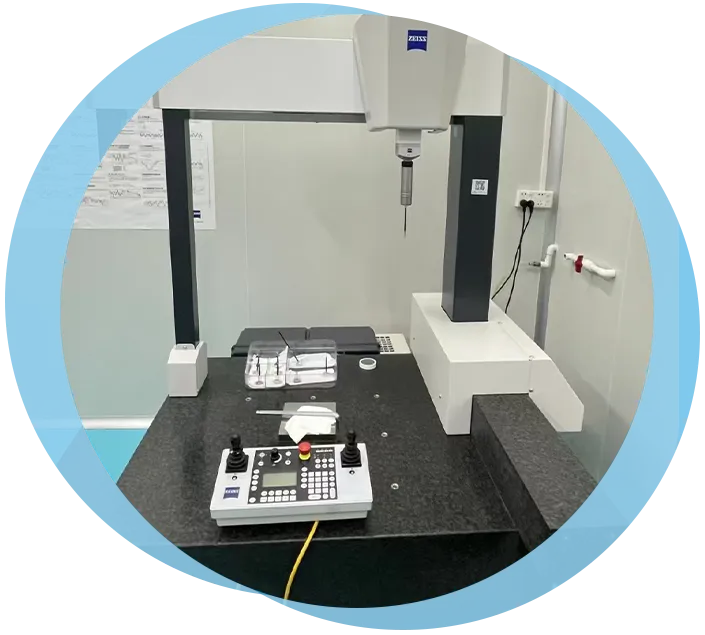
Yishun Optical’s Mitutoyo Crysta-Apex S500 high-precision CMM provides sub-micron measurement capability for mold validation throughout the fabrication process. Every optical surface is measured against the nominal CAD data, with deviation maps used to generate compensation parameters for subsequent machining or polishing steps. This closed-loop approach means that form errors are caught and corrected progressively, rather than discovered only at final inspection.
The S500’s capability extends to measuring complex freeform surfaces — the same geometries found in modern LED lens designs — allowing Yishun Optical to verify PV≤λ/4 form accuracy directly on the mold without requiring separate optical testing setups. This integrated metrology approach reduces cycle time and provides customers with comprehensive measurement documentation for every mold delivered.
Case Study: LED Headlight Lens Mold for a Major Automotive Brand
To illustrate the real-world impact of Yishun Optical’s capabilities, consider a recent program in which Yishun Optical developed the mold tooling for a matrix LED headlight lens assembly destined for a premium automotive brand’s next-generation platform.
The Challenge
The headlight design called for a 24-element matrix array, with each element requiring an individual lens cavity in the mold. The optical design specified freeform surfaces on each cavity to produce a specific beam distribution pattern, with surface form accuracy of PV≤λ/4 and surface finish of Ra≤0.005μm. The mold base needed to accommodate 24 cavities in a compact arrangement while maintaining ±0.005mm positional accuracy between all cavity centers.
Traditional approaches to this type of mold would involve sequential machining and hand polishing of each cavity, a process that typically requires 8-12 weeks and produces inconsistent results across cavities due to operator variability. The customer’s program timeline allowed only 6 weeks for mold completion, and the optical uniformity requirement across all 24 elements eliminated the possibility of selective hand correction.
Yishun Optical’s Solution
Yishun Optical’s process engineering team developed a customized machining strategy built around the Moore Nanotechnology 350FG. The team created parametric tool path programs that automatically adapted cutting parameters to the local surface curvature of each cavity, ensuring consistent surface quality across the varying geometries within each lens and across all 24 cavities. The Toshiba TTV450E-AX was used to machine the mold base and cavity pockets to the required positional accuracy before the optical surfaces were generated on the 350FG.
Throughout the machining process, the Mitutoyo Crysta-Apex S500 was used to measure each cavity after semi-finishing and again after final machining. Deviation data from the CMM was fed back into the 350FG’s compensation system, enabling iterative correction that brought every cavity within specification before any manual polishing was attempted. In practice, the precision of the 350FG’s machining was such that only minimal supplementary precision mold polishing was required — a testament to the effectiveness of Yishun Optical’s integrated process approach.
Results
The completed mold was delivered in 5.5 weeks, ahead of the 6-week deadline. All 24 lens cavities met the PV≤λ/4 form accuracy requirement on first validation, with no cavities requiring rework. Surface finish across all cavities measured Ra≤0.005μm. The customer’s injection molding trials produced lenses with optical performance that passed the automotive OEM’s beam pattern and uniformity specifications on the first submission.
Compared to the customer’s previous mold supplier’s approach, Yishun Optical’s integrated method reduced total mold fabrication time by approximately 35% and improved cavity-to-cavity uniformity by a factor of three. The customer subsequently engaged Yishun Optical for optical mold core customization on two additional lighting programs, including a through-type taillight assembly.
Quality Assurance and Industry Recognition
Yishun Optical’s commitment to quality extends beyond individual mold programs. The company operates under a comprehensive quality management system certified to ISO 9001, with additional certifications for environmental management (ISO 14001) and occupational health and safety (ISO 45001). These certifications reflect Yishun Optical’s systematic approach to process control, continuous improvement, and operational excellence.
Perhaps the most telling validation of Yishun Optical’s quality capabilities is its recognition as an Apple Gold Supplier. This designation, awarded to suppliers that consistently meet Apple’s exacting quality and delivery standards, demonstrates that Yishun Optical’s ultra-precision mirror machining capabilities are trusted by the most demanding consumer electronics manufacturers in the world. The same precision, consistency, and process rigor that earns Apple’s confidence is applied to every automotive optical mold that leaves Yishun Optical’s facility.
As a mirror mold manufacturer with proven capabilities in automotive optical mold machining, Yishun Optical serves as a technology partner rather than a simple contract machine shop. The company’s engineers work alongside customers’ optical design teams during the development phase, providing manufacturability feedback that can simplify lens geometries, reduce the number of mold cavities required, or identify surfaces that may push the limits of achievable form accuracy. This early collaboration helps automotive programs avoid costly mold revisions and keeps development timelines on track.
Yishun Optical’s investment in equipment, people, and process development positions the company to meet the escalating demands of automotive LED lighting programs. As headlight designs continue to evolve — with higher-resolution matrix systems, integrated sensor optics, and new lighting architectures — the need for a mirror mold manufacturer with genuine ultra-precision capability will only grow. Yishun Optical is already preparing for these next-generation requirements, with ongoing process development aimed at further reducing surface roughness and improving form accuracy on increasingly complex geometries.
FAQ
Q1: What surface finish can Yishun Optical achieve on LED headlight lens molds?
A: Yishun Optical routinely achieves surface finishes of Ra≤0.005μm on LED headlight lens molds through ultra-precision mirror machining on the Moore Nanotechnology 350FG. This mirror-grade surface finish is achieved directly from the machining process on most optical surfaces, with supplementary precision mold polishing applied only where needed to eliminate any residual tool marks.
Q2: What is the typical lead time for an automotive LED headlight lens mold?
A: For a standard single-piece lens mold, Yishun Optical typically delivers within 4-5 weeks. Complex multi-cavity molds, such as matrix LED arrays with 20+ elements, generally require 5-6 weeks. These lead times are 30-40% shorter than industry averages, enabled by Yishun Optical’s integrated machining workflow and in-process metrology using the Mitutoyo Crysta-Apex S500.
Q3: Can Yishun Optical handle optical mold core customization for complex freeform surfaces?
A: Yes. Optical mold core customization is one of Yishun Optical’s core competencies. The Moore Nanotechnology 350FG is specifically designed for generating complex freeform surfaces on mold inserts, including the non-rotationally-symmetric geometries found in matrix LED lenses, projector optics, and light guide plates. Yishun Optical’s process engineers develop customized tool paths for each unique geometry to ensure optimal surface quality and form accuracy.
Q4: What tolerances does Yishun Optical hold on automotive lens molds?
A: Yishun Optical holds the following key specifications on automotive LED headlight lens molds: surface roughness Ra≤0.005μm, surface form accuracy PV≤λ/4 (at 632.8 nm), and dimensional tolerances of ±0.005mm on all critical features. These capabilities are verified through in-process measurement on the Mitutoyo Crysta-Apex S500 coordinate measuring machine.
Q5: What certifications does Yishun Optical hold?
A: Yishun Optical holds ISO 9001 (quality management), ISO 14001 (environmental management), and ISO 45001 (occupational health and safety) certifications. Additionally, Yishun Optical is recognized as an Apple Gold Supplier, reflecting the company’s ability to meet the most demanding quality and delivery standards in precision manufacturing.
Q6: How does Yishun Optical ensure consistency across multi-cavity LED lens molds?
A: Consistency is achieved through three mechanisms: first, the Moore Nanotechnology 350FG provides exceptional repeatability across long machining runs; second, parametric tool path programs automatically adapt to each cavity’s geometry; and third, the Mitutoyo Crysta-Apex S500 measures every cavity during the machining process, with deviation data used for real-time compensation. This closed-loop approach ensures that all cavities in a multi-cavity mold meet the same PV≤λ/4 form accuracy requirement.
Q7: Does Yishun Optical provide support during the injection molding trial phase?
A: Yes. Yishun Optical provides comprehensive support through mold validation and initial production trials. This includes dimensional and optical measurement of first-article molded lenses, process optimization recommendations for the injection molding parameters, and mold adjustments if needed. Yishun Optical’s engineering team works directly with customers to ensure that the mold performs as intended in production conditions.
About Yishun Optical
Yishun Optical is a professional optical mold machining service provider headquartered in Shenzhen, China, specializing in ultra-precision mirror machining, optical mold core customization, precision mold polishing, and five-axis mirror machining. As a trusted mirror mold manufacturer, Yishun Optical serves the automotive manufacturing, consumer electronics, optical instruments, home appliances, and medical device industries with high-precision mold solutions.
The company’s capabilities are built around world-class equipment including the Moore Nanotechnology 350FG, Toshiba TTV450E-AX, and Mitutoyo Crysta-Apex S500, combined with deep process expertise developed through years of serving demanding international clients. Yishun Optical is an Apple Gold Supplier and holds ISO 9001, ISO 14001, and ISO 45001 certifications.
Contact: 0755-82594863
Core Services: Optical Mold Machining | Ultra-Precision Mirror Machining | Optical Mold Core Customization | Precision Mold Polishing | Five-Axis Mirror Machining