When a mold shop tells us a high gloss mold insert takes too long to finish, the problem is often not polishing alone.
The real delay may have started much earlier.
A traditional route can involve electrode preparation, EDM, removal of the EDM texture, several rounds of hand polishing, local correction and another round of inspection. None of those processes is automatically wrong. For many structures, EDM is still necessary.
The problem is what happens when too many steps are used on a surface that could have been finished more directly.
Every extra transfer adds time. Every extra correction step adds another chance for the surface, edge or dimension to move.
For a suitable high gloss mold insert, we first ask a different question:
Can we leave a much better surface directly from machining, so polishing only has to finish the surface instead of repair it?
Why the Traditional EDM-and-Polish Route Can Become Slow
A common mold-making sequence is easy to recognize.
Make the electrode.
Set up EDM.
Remove the spark texture.
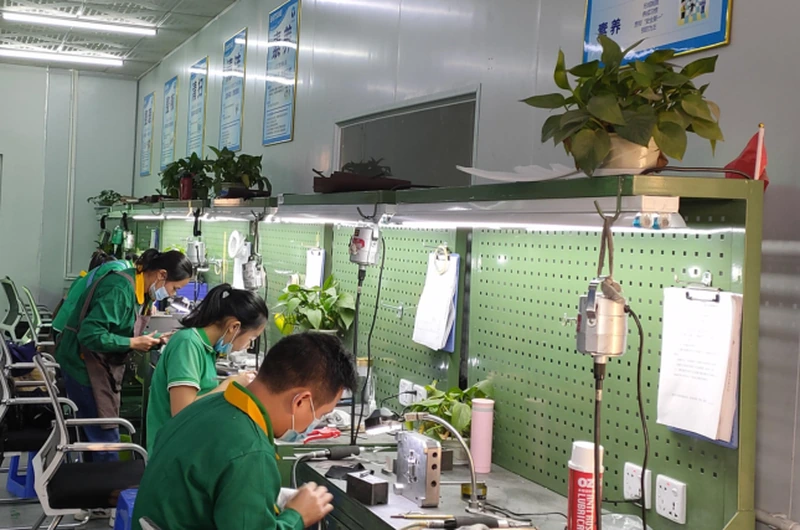
Hand polish the surface.
Check the appearance.
Polish again if tool marks, pits or texture are still visible.
This route has been used for years because it can solve difficult geometry and hard-to-reach features.
But on an open cavity or accessible curved surface, the same route may create more work than necessary.
The electrode takes time to make. EDM creates a surface that usually needs further finishing. Heavy manual polishing then has to remove that texture without changing the geometry.
If the customer is already under schedule pressure, those steps can become the longest part of the job.
This is why we do not start every project by assuming that EDM and heavy hand polishing must always be part of the process.
We first look at the geometry.
Open Surfaces Give Us More Machining Options
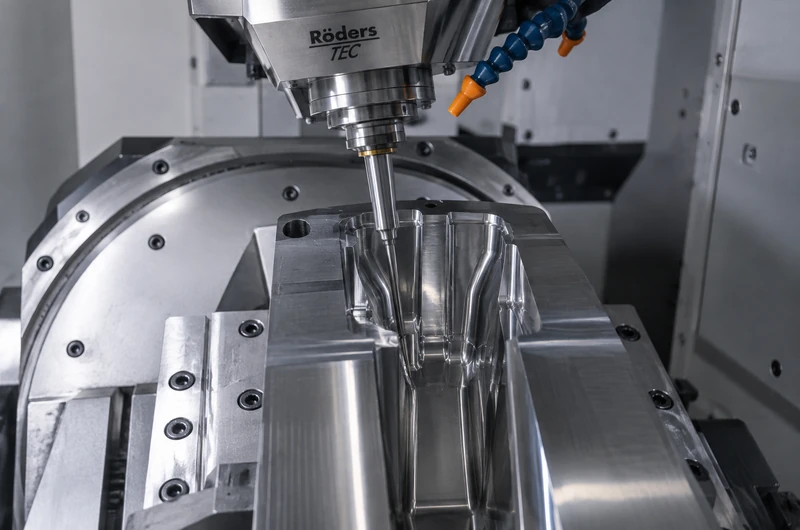
Mirror milling is most useful when the cutting tool can reach the critical surface in a stable way.
Open cavities, accessible freeform areas and some high-gloss cosmetic surfaces are good examples to evaluate.
With a rigid setup, a suitable small tool and a stable high-speed spindle, the machining process can leave a much finer starting surface than a conventional rougher route.
That does not mean the part comes off the machine and automatically needs no finishing.
It means the polishing team does not have to remove deep EDM texture or heavy cutter marks before the real finishing work begins.
For a high gloss mold insert, that difference matters.
The less correction required after machining, the easier it is to protect edges, radii and dimensional relationships.
This is one reason we use precision CNC machining as part of the process review instead of treating machining and polishing as two unrelated departments.
Mirror Milling Is About the Starting Surface, Not Just the Shine
We sometimes hear mirror milling described as if the only goal is to make the metal look bright.
That is too simple.
The real value is reducing the amount of correction left for later.
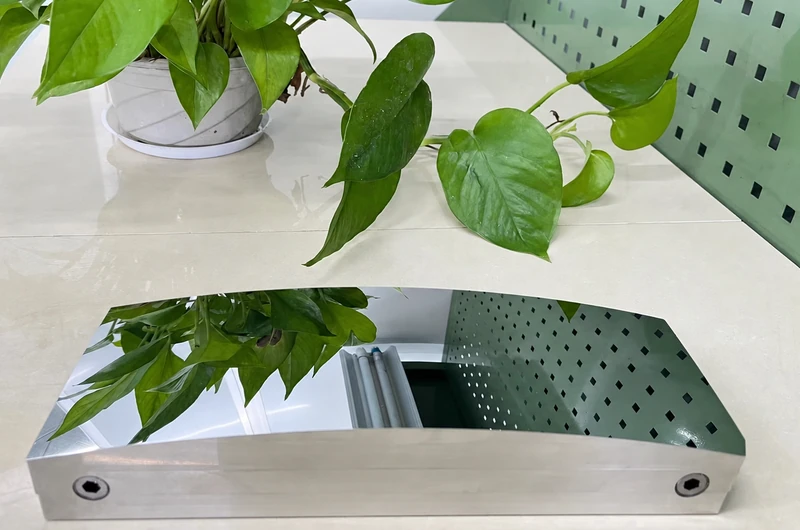
A stable mirror-milled surface can shorten the finishing route because there is less surface damage to erase.
This is especially useful when a high gloss mold insert has appearance-critical boundaries, small radii or areas where heavy polishing would be risky.
Our ultra-precision machining service includes high-speed and ultra-precision routes that we select according to material, geometry and surface requirement.
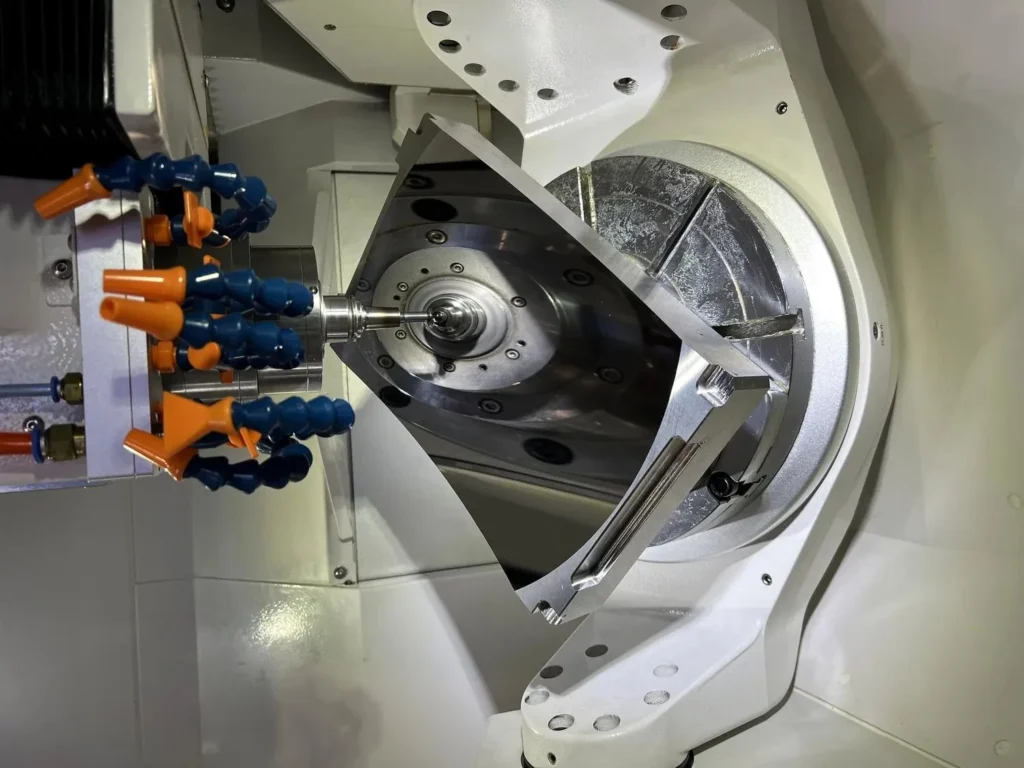
For suitable work, our Shibaura/Toshiba UVM equipment gives us the high-speed spindle capability needed for small-tool mirror machining.
But spindle speed by itself is not the answer.
Tool condition, runout, overhang, cutting depth, path continuity and machine stability still decide what kind of surface is left behind.
A fast spindle with an unstable cutting condition can still create a surface that needs a lot of polishing.
Fewer Process Steps Can Also Mean Fewer Reference Changes
Lead time is not the only reason we try to simplify the route.
Every time a part moves between processes, it has to be located, clamped and referenced again.
That may be completely manageable, but it adds another variable.
For a precision mold insert, especially one with a critical mirror surface related to surrounding dimensions, fewer unnecessary transfers can make the process easier to control.
This is one practical advantage of producing more of the surface condition during machining.
On a suitable high gloss mold insert, reducing electrode work, EDM finishing and heavy hand polishing can also reduce the number of times the part has to be corrected and rechecked.
The result we want is not simply a shorter routing sheet.
We want a more predictable routing sheet.
We Are Not Trying to Eliminate Polishing Completely
This point is important.
“Less hand polishing” does not mean “no polishing.”
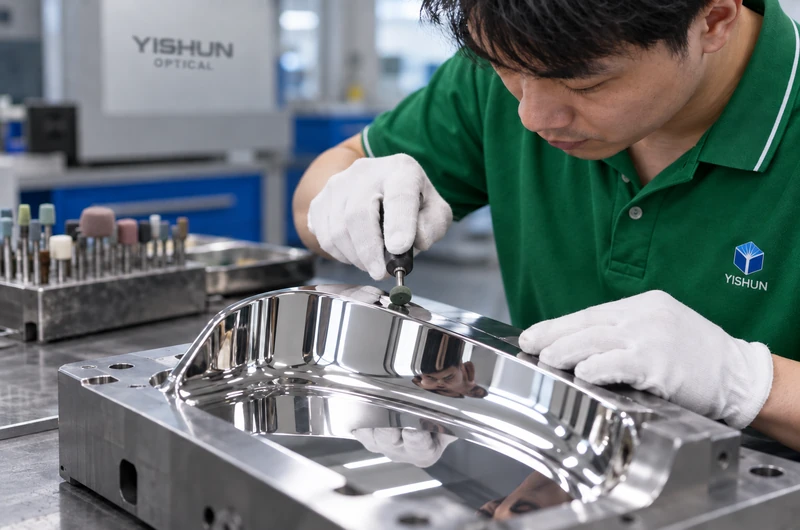
There are surfaces where light manual finishing is still the safest way to remove small residual marks or refine a local transition.
There are also shapes where robotic polishing can provide repeatability on accessible areas.
Our optical polishing services are used where finishing adds value without forcing the technician to correct problems that should have been solved during machining.
For a high gloss mold insert, we prefer polishing to be the final refinement step.
Once polishing becomes the main process for removing heavy machining or EDM defects, the risk of edge rounding, local depression and dimensional change increases.
That is exactly what we are trying to avoid.
Where EDM Is Still the Right Process
Mirror milling is not a universal replacement for EDM.
There are structures where the cutting tool simply cannot reach.
Very small internal corners, narrow deep cavities, hidden features and difficult sharp-corner geometry may still be better suited to EDM.
In those cases, trying to force a milling solution can create a worse result or an impractical tool setup.
The process should follow the geometry.
A high gloss mold insert may even use more than one route on the same part: mirror milling on the accessible optical or cosmetic surface, EDM on an unreachable corner, and controlled polishing only where it is actually needed.
That is usually more realistic than insisting that one process should do everything.
The Biggest Saving Is Often in the Rework We Never Have to Do
The obvious saving from a shorter process is lead time.
But the larger saving can be avoiding repeated correction.
When a surface arrives at the polishing bench with deep texture, the technician may spend hours trying to remove it.
If the result still has a visible line, the part goes back for another correction.
If the edge changes, it may need another dimensional review.
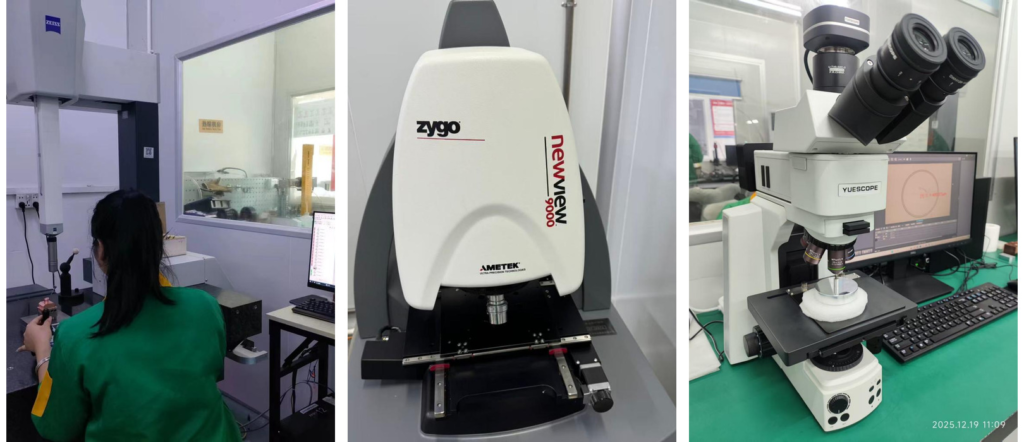
If too much material is removed, the insert may no longer be recoverable.
A better starting surface changes that entire chain.
For the right part, the polishing stage becomes shorter, lighter and easier to control.
That is much more valuable than simply saying the machine can produce a shiny surface.
How We Decide Whether Mirror Milling Can Reduce the Process
When we review a drawing, we look at the mirror area first.
Is it open or blocked?
Can the tool reach it without excessive overhang?
Are there sharp internal corners that require another process?
What material is being used?
Which dimensions must remain stable after finishing?
Which areas are cosmetic, and which are functional?
Those answers tell us whether a high gloss mold insert is a good candidate for a simplified machining route.
Sometimes the answer is yes: direct high-speed mirror machining can remove several traditional steps.
Sometimes only part of the surface is suitable.
And sometimes EDM remains the better choice.
The decision has to be made from the actual geometry, not from a general claim that one technology is “better.”
Can Mirror Milling Completely Replace EDM?
No.
It can reduce or replace EDM on suitable accessible surfaces, but it does not solve every internal corner, deep cavity or unreachable feature.
The correct process depends on tool access, material, geometry and finish requirements.
Does a High Gloss Mold Insert Still Need Polishing After Mirror Milling?
Often, yes—but usually less.
If the machined starting surface is stable and already close to the required finish, polishing can be used as a controlled refinement step rather than a heavy correction process.
That is the situation we prefer.
Does Reducing Hand Polishing Improve Lead Time?
It often can.
Electrode preparation, EDM, texture removal and repeated polishing all take time. If the geometry allows some of those steps to be reduced, the overall route can become shorter and more predictable.
The actual saving still depends on the part.
What Should You Send Us for a Process Review?
Send the 2D drawing, 3D model, material, mirror-finish areas, critical tolerances and any internal corners or features that must remain sharp.
We can review where mirror milling makes sense, where EDM is still necessary and how much finishing should remain after machining.
For the right part, the goal is not to remove every traditional process.
It is to remove the unnecessary ones.