Comparing domestic vs overseas precision machining on unit price alone frequently leads to budget overruns and missed launch schedules. While overseas suppliers often present lower direct machining rates, the true cost of Ultra Precision Machining Services is determined by Total Cost of Ownership (TCO)—which combines direct manufacturing expenses with freight, customs duties, metrology alignment, rework risk, engineering communication overhead, and inventory carrying costs.
For B2B procurement teams and engineering managers, the lower-TCO option depends on four primary variables: production volume, process integration requirements, design stability, and tolerance sensitivity. Domestic shops generally deliver lower total cost for urgent prototypes, frequent design iterations, and restricted programs. Overseas specialists often win on TCO for stable designs, multi-process optical or mechanical components, and mid-to-high production volumes where lower hourly rates and integrated workflows outweigh logistics and oversight costs.

This guide breaks down the complete TCO formula, compares domestic and offshore ultra precision machining across operational dimensions, highlights hidden cost multipliers unique to micron- and nanometer-level tolerances, and provides a practical sourcing framework for making an objective decision.
What Actually Makes Up Total Cost of Ownership in Ultra Precision Machining?
Total Cost of Ownership in precision manufacturing represents the sum of all direct and indirect expenses required to source, inspect, transport, and integrate a finished component into your assembly or production line. Evaluating a quote without accounting for downstream operational costs distorts supplier comparisons.
Direct Manufacturing Costs vs. Landed and Lifecycle Costs
Direct manufacturing costs appear on the initial quotation. These include raw material procurement, CAM programming, custom fixturing, machine runtime across processes such as single-point diamond turning, 5-axis milling, precision grinding, and optical polishing, as well as surface treatments or coatings.
Landed and lifecycle costs occur after the part leaves the spindle. They cover export-grade protective packaging, international air or sea freight, customs brokerage, import tariffs, incoming quality inspection, engineering time spent resolving DFM questions, safety stock financing, and the financial impact of rejected parts or line-down delays.
A Practical TCO Formula for B2B Sourcing Teams
To calculate TCO for precision machined parts consistently across domestic and overseas quotes, sourcing teams can apply the following baseline formula:
TCO = Direct Part & Tooling Cost + Landed Logistics Cost + Quality & Metrology Cost + Rework/Scrap Risk Cost + Inventory & Lead-Time Carrying Cost
| Cost Category | Visibility on Quote | Primary Cost Drivers |
|---|---|---|
| Direct Manufacturing | Explicit | Raw material grade, machine hourly rate, cycle time, custom fixtures, multi-process setups |
| Finishing & Secondary Ops | Explicit or Optional | Optical polishing, nickel plating, anti-reflective coatings, deburring, ultrasonic cleaning |
| Logistics & Trade Compliance | Partial (depends on Incoterms) | Air/ocean freight, protective packaging, customs clearance, import duties, insurance |
| Quality & Metrology | Often Hidden | First Article Inspection (FAI), third-party lab verification, incoming QA labor, metrology correlation |
| Engineering & Communication | Hidden | DFM review cycles, drawing clarifications, time-zone coordination, revision management |
| Risk & Inventory Carrying | Hidden | Scrap replacement, expedited replacement shipping, safety stock capital, production delay penalties |
When evaluating complex multi-step components—such as optical mold inserts or precision mechanical housings—consolidating turning, milling, grinding, and polishing under one provider of ultra precision machining services directly reduces setup transfers, secondary vendor markups, and cumulative tolerance stack-up.
Domestic vs. Overseas Ultra Precision Machining: Cost and Operational Comparison
Domestic and offshore suppliers operate under different cost structures and supply chain constraints. The table below outlines how each sourcing model performs across the core factors that drive total cost.
| Evaluation Factor | Domestic Sourcing | Overseas Sourcing | TCO Impact |
|---|---|---|---|
| Direct Machining & Labor Rate | Higher hourly machine and skilled technician rates | Generally lower hourly rates and overhead | Favors overseas, especially on labor-intensive or long-cycle parts |
| Multi-Process Integration | Often fragmented across separate machining, plating, and polishing vendors | Frequently consolidated within specialized industrial clusters or integrated facilities | Favors overseas when multiple precision steps are required |
| Freight, Packaging & Duties | Low domestic ground/air shipping; no import tariffs | International freight, customs duties, and specialized export packaging | Favors domestic, particularly for heavy parts or small emergency batches |
| Lead Time & Iteration Speed | Shorter transit times; faster physical sample turnaround | Longer transit and customs clearance; requires tighter production planning | Favors domestic for rapid prototyping and frequent design changes |
| Metrology & Quality Alignment | Easier on-site audits and direct lab-to-lab correlation | Requires upfront agreement on inspection equipment, data formats, and acceptance criteria | Neutral if standardized upfront; favors domestic if specs are loosely defined |
| Inventory Carrying Cost | Supports smaller, more frequent replenishment orders | Often requires higher safety stock to buffer transit variability | Favors domestic for lean, just-in-time programs |
| IP Protection & Compliance | Governed by local legal frameworks; required for export-controlled defense/aerospace work | Managed via enforceable NDAs, vetted supplier policies, and controlled file access | Favors domestic for regulated/restricted sectors; manageable overseas for commercial IP |
Actual cost differences vary significantly depending on part geometry, material availability, batch size, and applicable trade terms. Sourcing teams should populate these categories with real project quotes rather than relying on general industry rules of thumb.
Hidden Cost Multipliers That Skew Overseas vs. Domestic Calculations
In standard CNC machining, a minor dimensional discrepancy can sometimes be reworked locally at modest expense. In ultra precision machining—where components require micron-level dimensional accuracy and nanometer-level surface roughness—small process or communication failures multiply TCO rapidly.
Scrap, Rework, and Metrology Mismatch at Micron and Nanometer Tolerances
Optical components, mold cores, and precision mechanical interfaces leave virtually no margin for post-shipment correction. If a part arrives out of form accuracy or surface finish specification, local rework is rarely feasible without damaging critical datums or coatings.
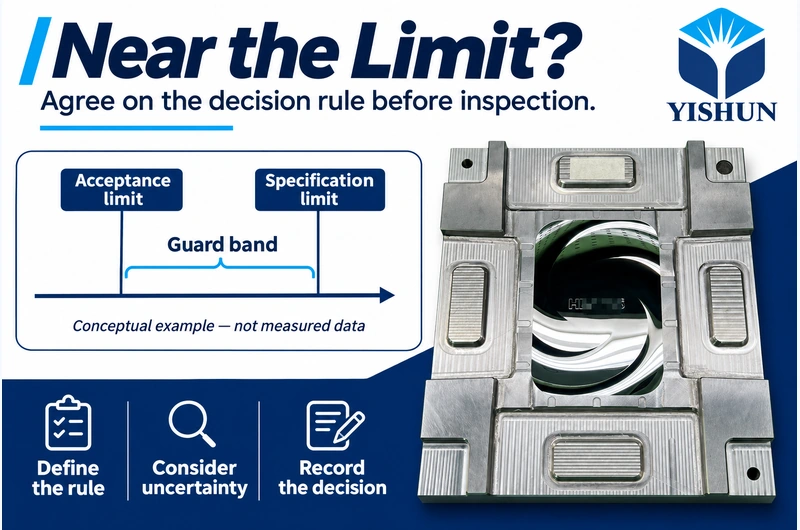
A frequent trigger for disputes is metrology mismatch. If the supplier measures surface roughness or form error using a different instrument type, filtering parameter, or environmental setup than the buyer’s incoming QA lab, parts that pass outgoing inspection may fail incoming inspection. Working with a supplier that provides optical-grade ultra precision machining services backed by documented, aligned metrology—such as white light interferometry, profilometry, and coordinate measuring machines (CMM)—prevents costly cross-border rejection cycles.
Engineering Communication Loops and Design Revision Delays
Time-zone differences and unclear technical handoffs turn minor drawing ambiguities into multi-day delays. When GD&T callouts, datum structures, or material heat-treatment states are not clarified during the quoting stage, shops may make assumptions that lead to non-conforming parts. Each round of revision across international borders adds engineering labor hours and pushes back downstream assembly schedules.
Packaging Damage, Logistics Volatility, and Safety Stock
Ultra-precision surfaces are highly vulnerable to micro-scratches, corrosion, and vibration-induced damage during international transit. Standard bulk packaging is insufficient for mirror-finished optical inserts or delicate thin-walled structures. Additionally, longer ocean or air freight windows require buyers to hold higher safety stock, tying up working capital and increasing obsolescence risk if a product undergoes a mid-cycle engineering change.
| Hidden Cost Trigger | Operational Consequence | Practical Prevention Measure |
|---|---|---|
| Unaligned Metrology Standards | Parts pass supplier QA but fail buyer incoming inspection | Define inspection equipment, sampling plans, and raw data report formats before PO issuance |
| Incomplete GD&T or Datum Callouts | Incorrect machining setups and scrapped first articles | Require a formal DFM review and written clarification of critical tolerances prior to cutting |
| Inadequate Export Packaging | Surface scratches, oxidation, or edge chipping in transit | Specify cleanroom-grade, anti-static, vacuum-sealed, and shock-isolated packaging requirements |
| Unverified Sub-Tier Outsourcing | Inconsistent plating, heat treatment, or polishing quality | Confirm which processes are performed in-house and how sub-tier vendors are audited |
How to Decide: Domestic, Overseas, or a Hybrid Sourcing Strategy?
No single sourcing model delivers the lowest TCO across every project phase. High-performing procurement teams match the sourcing strategy to the technical maturity and commercial profile of the part.
When Domestic Ultra Precision Machining Wins on TCO
Keeping production domestic typically produces the lowest total cost when:
- Design iteration is rapid: Early R&D prototypes require multiple physical revisions within tight engineering sprints.
- Volumes are very low: One-off fixtures or single prototype pieces do not generate enough unit-price savings to offset international air freight and customs brokerage.
- Regulatory restrictions apply: Projects fall under strict domestic-sourcing mandates, defense regulations, or government compliance frameworks.
- Immediate on-site collaboration is required: Complex assembly troubleshooting demands engineers on the shop floor.
When Overseas Ultra Precision Machining Delivers Lower TCO
Outsourcing precision machining overseas generally achieves superior TCO when:
- Designs are frozen and well-documented: Clear 2D/3D drawings and defined inspection protocols eliminate costly communication loops.
- Parts require multi-process workflows: Components needing precision turning, 5-axis milling, grinding, and optical polishing benefit from specialized overseas hubs where these processes are integrated.
- Production scales to mid or high volumes: Lower per-part machining costs amortize freight, duties, and initial qualification expenses across larger batches.
- Lead times are planned in advance: Forecasted demand allows for standard shipping schedules rather than emergency air freight.
The Hybrid Approach: Domestic Prototyping with Overseas Scaling
Many international OEMs adopt a hybrid strategy to capture the strengths of both models. Engineering teams use domestic shops for rapid early-stage functional validation, then transition frozen designs to a qualified overseas optical mold machining supplier for pilot runs and full-scale production. Alternatively, when an overseas supplier demonstrates fast DFM responsiveness and reliable sample turnaround, buyers consolidate both prototyping and production with that single partner to avoid re-qualifying tooling and metrology during scale-up.
| Project Scenario | Recommended Sourcing Model | Primary TCO Reason |
|---|---|---|
| Urgent R&D Prototype (1–5 units, frequent revisions) | Domestic | Avoids international transit delays and high per-unit freight overhead |
| Export-Controlled / Regulated Aerospace or Defense Part | Domestic | Mandatory legal compliance eliminates offshore viability |
| Complex Optical Mold Insert (Multi-process, stable design) | Overseas | Integrated machining and polishing workflows reduce total fabrication cost |
| Mid-to-High Volume Precision Mechanical Components | Overseas | Direct unit-cost savings substantially outweigh landed logistics expenses |
| New Product Launch with Tight Schedule & High Volume Target | Hybrid | Balances domestic speed during design freeze with overseas cost efficiency at scale |
How to Control Hidden Costs When Sourcing Ultra Precision Machining Overseas
Selecting an overseas partner lowers TCO only when quality, communication, and logistics risks are actively managed. Before awarding a production order, procurement and engineering teams should verify six core controls:
- Demand Itemized Quotes Under Consistent Incoterms: Require suppliers to separate raw material, programming/tooling, machining, surface finishing, packaging, and shipping costs. Compare quotes using the same Incoterms (such as EXW, FOB, or DDP) so landed costs are evaluated on an equal basis.
- Establish Metrology Parity Upfront: Confirm that the supplier possesses appropriate inspection equipment for your critical features and agrees to supply full First Article Inspection (FAI) and outgoing inspection reports before shipment.
- Verify In-House Process Capabilities: Ask which machining, grinding, and polishing steps are completed internally versus subcontracted. Greater in-house control reduces lead-time variability and quality handoff errors.
- Evaluate DFM Responsiveness During Quoting: Use the RFQ stage as a live test of engineering communication. A capable supplier will proactively flag tolerance stack-ups, thin-wall risks, or tooling access issues rather than simply returning a low price.
- Enforce IP Protection and NDA Protocols: Execute a mutual Non-Disclosure Agreement (NDA) prior to sharing sensitive CAD models, and confirm how the supplier restricts digital file access on the shop floor.
- Validate With a Structured Pilot Run: Before committing to high-volume orders, run a small qualification batch to verify dimensional repeatability, surface finish consistency, protective packaging integrity, and actual transit times.
Working with an established specialist that builds these controls into its standard workflow simplifies overseas risk mitigation. For buyers evaluating China-based partners, YISHUN’s ultra precision machining services support transparent DFM reviews, NDA-protected file handling, and documented inspection workflows designed to keep landed costs predictable from initial sample through volume production.
Get a Transparent Cost Breakdown for Your TCO Comparison
Choosing between domestic and overseas Ultra Precision Machining Services is not a question of finding the lowest hourly rate—it is an exercise in matching total landed cost and operational risk to your project’s specific stage and tolerance requirements. Domestic suppliers protect schedules during rapid, early-stage iteration, while qualified overseas partners deliver substantial TCO advantages once drawings are stabilized and multi-process precision or volume scaling becomes the priority.
To build an accurate, side-by-side TCO comparison for your upcoming project, prepare the following inputs before requesting quotes:
- 2D drawings and 3D CAD models with clearly marked critical-to-quality (CTQ) tolerances and surface roughness callouts
- Material specifications and any required heat-treatment or coating standards
- Target order quantities (initial prototype, pilot run, and forecasted annual volume)
- Preferred Incoterms and target delivery schedule
Sharing complete technical and commercial parameters upfront allows both domestic and overseas suppliers to provide realistic, itemized quotes—giving your team the exact data needed to make a confident sourcing decision.
Key Takeaways
- Unit price does not equal Total Cost of Ownership (TCO): True sourcing cost combines direct machining and tooling with freight, customs duties, metrology alignment, engineering communication, rework risk, and inventory carrying costs.
- Ultra-precision tolerances amplify hidden costs: At micron and nanometer levels, metrology mismatches, incomplete GD&T callouts, or inadequate export packaging can trigger full-batch scrap that erases overseas unit-price savings.
- Domestic sourcing wins on speed and iteration: Urgent prototypes, low-volume one-offs, frequent design changes, and export-controlled projects generally achieve lower TCO domestically.
- Overseas sourcing wins on scale and process integration: Frozen designs, multi-process optical or mechanical parts (turning, milling, grinding, polishing), and mid-to-high production volumes typically achieve lower TCO with qualified overseas specialists.
- Risk mitigation locks in overseas savings: Itemized quotes under consistent Incoterms, upfront metrology alignment, DFM reviews, NDAs, and pilot-run validation are essential to prevent hidden costs from eroding offshore margins.
FAQ
How much cheaper is overseas ultra precision machining after shipping and tariffs?
The net savings vary widely depending on part complexity, cycle time, material weight, batch size, and applicable import tariffs. High-labor, multi-process components in mid-to-high volumes typically show meaningful landed-cost savings overseas, whereas heavy, low-volume parts shipped via expedited air freight may offer little or no TCO advantage over domestic shops. Exact savings should be calculated using itemized quotes for your specific part.
What Incoterms should I request when comparing overseas and domestic quotes?
To compare domestic and overseas quotes fairly, request Delivered Duty Paid (DDP) or ask your freight forwarder to add estimated freight, insurance, customs clearance, and duties to an EXW or FOB overseas quote. Comparing an overseas EXW price directly against a domestic delivered price omits major landed-cost components.
How can I verify micron or nanometer tolerances before parts ship from overseas?
Require a First Article Inspection (FAI) package and outgoing quality inspection reports prior to shipment approval. Confirm in advance which metrology instruments—such as CMM, white light interferometers, or surface profilometers—will be used, and agree on the measurement parameters and acceptance criteria before production begins.
Is it safe to send proprietary optical or mechanical CAD files to an overseas machine shop?
Commercial IP can be protected effectively when working with vetted, export-oriented suppliers. Standard precautions include executing a mutual NDA before transferring files, sharing only the technical data necessary for manufacturing, confirming internal file-access controls, and avoiding unverified brokers. Projects subject to government export controls should remain domestic.