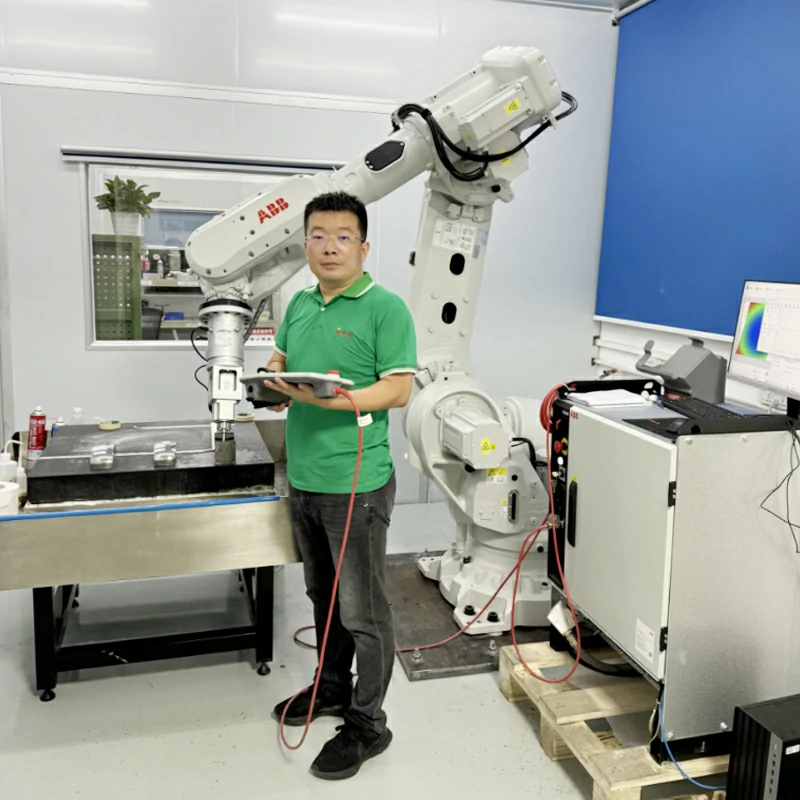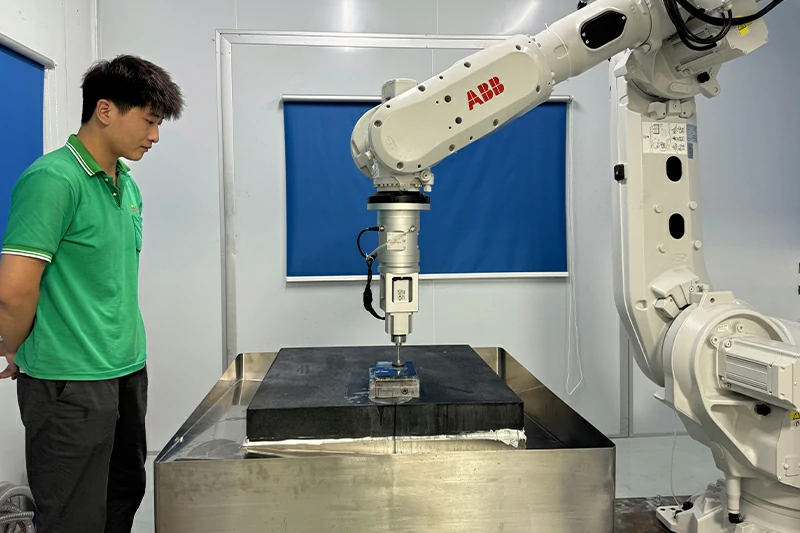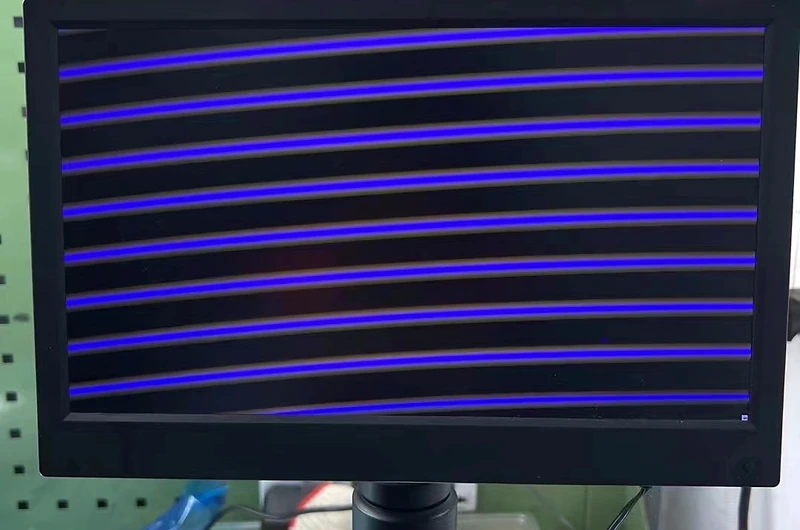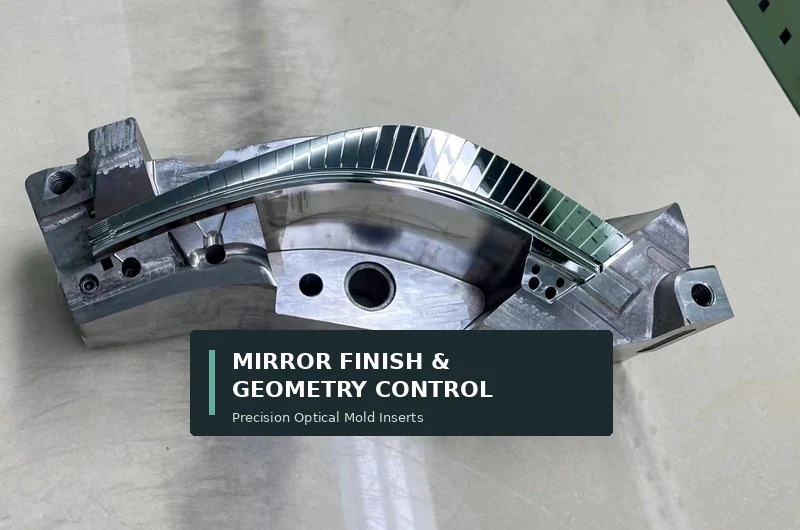
When precision optical components demand surface accuracies measured in nanometers, the choice between pitch polishing vs magnetorheological finishing (MRF) becomes critical. Both techniques deliver exceptional surface quality, yet their operational principles, material removal mechanisms, and ideal applications differ significantly. Understanding these differences enables optical engineers and procurement specialists to select the optimal fabrication method for their specific requirements.
For over 20 years, YISHUN Optical has applied both techniques across diverse industries including high-reliability optical, semiconductor, and medical device manufacturing. This expertise informs our comprehensive comparison of these two precision finishing methods.
Key Takeaway:
- Pitch polishing excels in achieving Ra <1nm surfaces on spherical and aspherical optics through mechanical polishing action
- MRF provides deterministic material removal for correcting mid-spatial-frequency errors and wavefront aberrations
- Hybrid approaches combining both techniques yield the highest-quality optical surfaces
- Material compatibility differs significantly between the two methods
- Process selection depends on surface geometry, quality requirements, and production volume
Understanding Pitch Polishing Technology
Pitch polishing represents one of the oldest and most refined optical finishing techniques, utilizing a viscoelastic polishing pitch (derived from tar or synthetic compounds) as the polishing interface. The pitch conforms to the workpiece surface under pressure, creating intimate contact that enables molecular-level material removal.
How Pitch Polishing Works
The process involves applying polishing slurry (typically cerium oxide or aluminum oxide particles in suspension) between the pitch tool and the optical surface. Key operational parameters include:
| Parameter | Typical Range |
|---|---|
| Pitch Hardness | 15-45 Shore D |
| Polishing Pressure | 0.5-2.0 kPa |
| Spindle Speed | 20-80 rpm |
| Slurry Flow Rate | 50-200 mL/min |
| Surface Roughness | Ra 0.3-1.5 nm |
The viscoelastic nature of pitch allows it to “flow” and conform to surface irregularities, progressively smoothing micro-relief through a combination of mechanical abrasion and chemical-mechanical interactions. This conformal contact enables pitch polishing to effectively address both high-frequency (roughness) and certain mid-spatial-frequency errors.
Advantages of Pitch Polishing
- Exceptional Surface Smoothness: Achieves Ra values below 1nm, ideal for laser-grade optics and interferometer components
- Broad Material Compatibility: Effective on glass, ceramics, crystalline materials, and precision metal alloys
- Geometric Flexibility: Accommodates spherical, aspherical, and custom surface geometries
- Proven Reliability: Decades of industrial validation and process optimization
- Cost-Effectiveness: Lower equipment investment compared to MRF systems
Limitations of Pitch Polishing
- Lower Removal Efficiency: Material removal rates typically range 0.1-0.5 μm/hour, extending process times
- Less Deterministic: Removal distribution depends heavily on process parameters and operator skill
- Limited Correction Capability: Less effective for correcting figure errors or wavefront aberrations beyond roughness
Understanding Magnetorheological Finishing (MRF)
Magnetorheological finishing represents a more recent advancement in precision optics manufacturing, employing a magnetically-responsive fluid that stiffens under electromagnetic field application. This “smart fluid” enables highly controlled, deterministic material removal patterns.
How MRF Technology Operates
The MRF process circulates a magnetorheological fluid (containing carbonyl iron particles, abrasives, and carrier liquid) between a rotating wheel and the workpiece. When the magnetic field engages, the fluid exhibits yield strength proportional to field intensity, creating a flexible polishing “lath” that removes material with exceptional precision.
| Parameter | MRF Specification |
|---|---|
| Removal Function | Gaussian or custom-profiled |
| Removal Depth | 0.01-10 μm per pass |
| Surface Accuracy | λ/20-λ/50 (wavefront) |
| Material Removal Efficiency | 5-20× faster than pitch |
| Applicable Materials | Glass, SiC, ZnSe, germanium, sapphire |
The deterministic nature of MRF—where material removal follows predictable mathematical functions—enables precise correction of optical figure errors, wavefront aberrations, and mid-spatial-frequency ripples that degrade optical performance.
MRF Advantages in Precision Optics
- Deterministic Correction: Computer-controlled removal functions enable precise wavefront correction
- High Efficiency: Material removal rates 5-20× faster than conventional pitch polishing
- Sub-aperture Processing: Effective for correcting localized figure errors without full-surface retouching
- Repeatability: Closed-loop control ensures consistent results across production batches
- Brite-Zone Correction: Excels at eliminating mid-spatial-frequency errors critical for laser system performance
MRF Limitations
- Higher Equipment Cost: MRF systems require significant capital investment
- Geometry Constraints: Wheel geometry limits access to certain complex surface features
- Surface Roughness Ceiling: Typically achieves Ra 1-3nm, potentially requiring pitch polishing as a final step for ultra-smooth surfaces
- Material Restrictions: Less effective on certain exotic optical materials
Pitch Polishing vs MRF: Direct Comparison
| Aspect | Pitch Polishing | Magnetorheological Finishing |
|---|---|---|
| Surface Roughness | Ra 0.3-1.5 nm (ultra-smooth) | Ra 1-3 nm (excellent) |
| Figure Correction | Limited | Exceptional (λ/50) |
| Removal Efficiency | Low (0.1-0.5 μm/hr) | High (0.5-5 μm/hr) |
| Process Determinism | Empirical/operator-dependent | Mathematical/computer-controlled |
| Equipment Cost | Moderate | High |
| Lead Time | Longer | Shorter |
| Best For | Final smoothing, laser mirrors | Figure correction, aspheric smoothing |
| Geometric Freedom | High | Moderate |
| Operator Skill Required | High | Moderate |
When to Select Pitch Polishing
Pitch polishing becomes the preferred choice under specific conditions:
Ideal Applications for Pitch Polishing
- Laser-Grade Optical Components Components requiring surface roughness below Ra 1nm for minimal scatter losses benefit from pitch polishing’s molecular-level smoothing capability.
- Interferometer and Metrology Optics Reference flats, spherical mirrors, and null optics where subsurface quality and micro-roughness directly impact measurement accuracy.
- High-Value Single-Piece or Low-Volume Optics When production quantities don’t justify MRF tooling costs, pitch polishing delivers comparable surface quality economically.
- Complex Geometries Freeform surfaces, off-axis aspheres, and optics with complex topology that challenge MRF wheel access.
- Final Surfacing After MRF Pitch polishing often serves as the final “stouch” step after MRF correction, combining MRF’s figure accuracy with pitch’s ultimate smoothness.
When to Select MRF
MRF technology excels in scenarios requiring deterministic correction and high throughput:
Ideal Applications for MRF
- Precision Aspherical Optics Aspheric lenses and mirrors that require both figure correction and surface smoothing benefit from MRF’s computer-controlled removal functions.
- Laser System Optics High-power laser components requiring both λ/20+ wavefront accuracy and minimal mid-spatial-frequency errors that cause beam quality degradation.
- Volume Production Runs When production quantities justify tooling costs, MRF’s speed and repeatability accelerate delivery schedules.
- Pre-existing Figure Errors Optics requiring correction of wavefront aberrations introduced during grinding or earlier machining operations.
- Silicon Carbide and Hard Materials MRF effectively processes difficult materials like SiC that challenge conventional pitch polishing efficiency.
Hybrid Approach: Combining Pitch and MRF
Industry-leading optical manufacturers increasingly employ hybrid processes that leverage each technique’s strengths:
Sequential MRF → Pitch Polishing:
- MRF Phase: Correct figure errors, eliminate mid-spatial-frequency ripples, achieve λ/20+ wavefront accuracy
- Pitch Polishing Phase: Final micro-smoothing to achieve Ra <1nm surface roughness
This combination delivers optics that simultaneously satisfy the most demanding wavefront specifications and ultra-smooth surface requirements—critical for lithography optics, high-power lasers, and high-reliability optical sensors.
YISHUN Optical maintains both capabilities in-house, enabling us to recommend and implement the optimal finishing sequence for each application’s requirements.
Material Considerations: Pitch Polishing vs MRF
Different optical substrate materials respond preferentially to each technique:
| Material | Pitch Polishing | MRF | Recommended Approach |
|---|---|---|---|
| Fused Silica | Excellent | Excellent | Either (MRF→Pitch for best results) |
| Borosilicate Glass | Excellent | Excellent | Either |
| Schott Glass (SF, N-BK7) | Excellent | Excellent | Either |
| Sapphire | Good | Good | MRF for efficiency, Pitch for finish |
| Silicon Carbide | Moderate | Excellent | MRF primary, Pitch secondary |
| Zinc Selenide | Good | Excellent | MRF preferred (toxicity concerns) |
| Germanium | Good | Excellent | MRF preferred |
| ULE/Ceramic | Moderate | Good | Pitch primary |
Making the Right Choice: Decision Framework
When evaluating pitch polishing vs MRF for your optical component, consider this decision framework:
Select Pitch Polishing When:
- Surface roughness specification is Ra <1nm
- Component geometry is complex or freeform
- Production volume is low to moderate
- Budget constraints limit equipment investment
- Final surfacing after MRF correction
Select MRF When:
- Figure correction requirements exceed λ/20
- Mid-spatial-frequency error control is critical
- Production volume justifies tooling investment
- Sub-aperture correction is needed
- Material is difficult-to-process (SiC, ZnSe)
Select Hybrid (MRF + Pitch) When:
- Both figure accuracy (λ/20+) and surface smoothness (Ra <1nm) are required
- Components serve high-power laser or precision metrology applications
- Quality requirements justify additional processing cost
Conclusion
The pitch polishing vs MRF decision fundamentally shapes optical component quality, production efficiency, and cost structure. Neither technique universally outperforms the other—each excels in specific application domains.
Pitch polishing delivers unmatched surface smoothness for laser-grade and metrology optics, offering broad geometric flexibility and proven reliability across decades of industrial practice.
MRF technology provides deterministic figure correction and superior throughput for aspheric optics, volume production, and applications requiring precise wavefront control.
Hybrid approaches increasingly represent best practice for components demanding both exceptional figure accuracy and ultra-smooth surfaces simultaneously.
At YISHUN Optical, our 20+ years of precision optics manufacturing experience encompasses both techniques. Our applications engineers evaluate each project’s specific requirements—material, geometry, quality specifications, and volume—to recommend the optimal finishing strategy.
Contact us at info@yishunoptical.com or visit yishunoptical.com to discuss your precision optical finishing requirements.
YISHUN Optical delivers ISO 9001:2015 certified precision optical components with Ra 1nm surface roughness and ±0.5μm tolerance capabilities. Our capabilities include pitch polishing, MRF finishing, and hybrid processes for the most demanding optical applications.