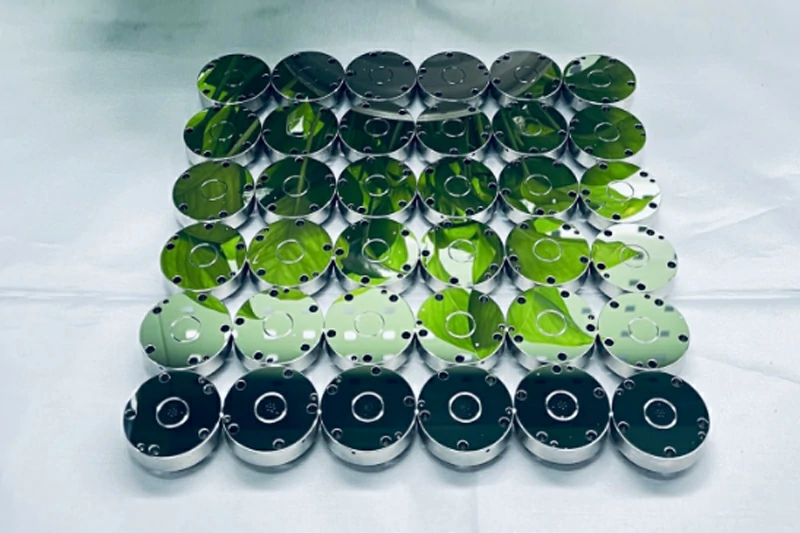
Single point diamond turning, commonly abbreviated as SPDT, is an ultra-precision machining process that uses a carefully controlled single-crystal diamond cutting tool to generate highly accurate surfaces directly on suitable materials.
Unlike conventional turning, SPDT combines an ultra-precision spindle, nanometer-scale motion control, thermal stability, precision fixturing, and an extremely sharp diamond cutting edge.
Single point diamond turning is particularly valuable when a component requires both highly controlled geometry and a very smooth surface directly from machining.
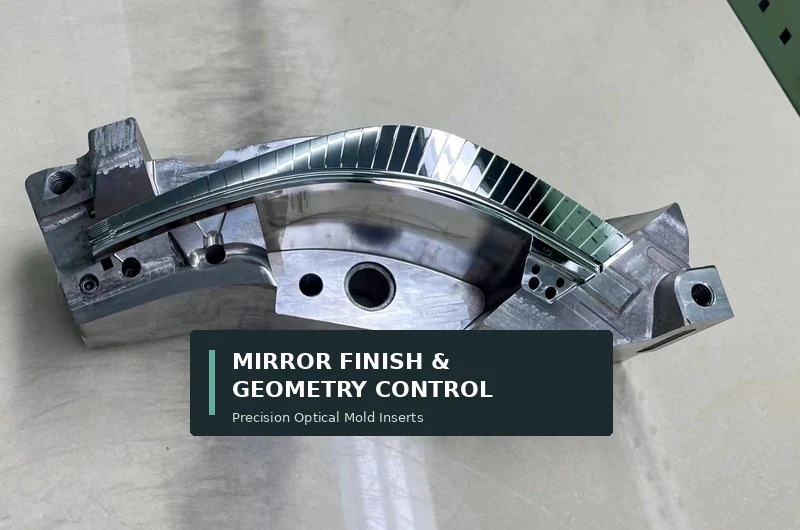
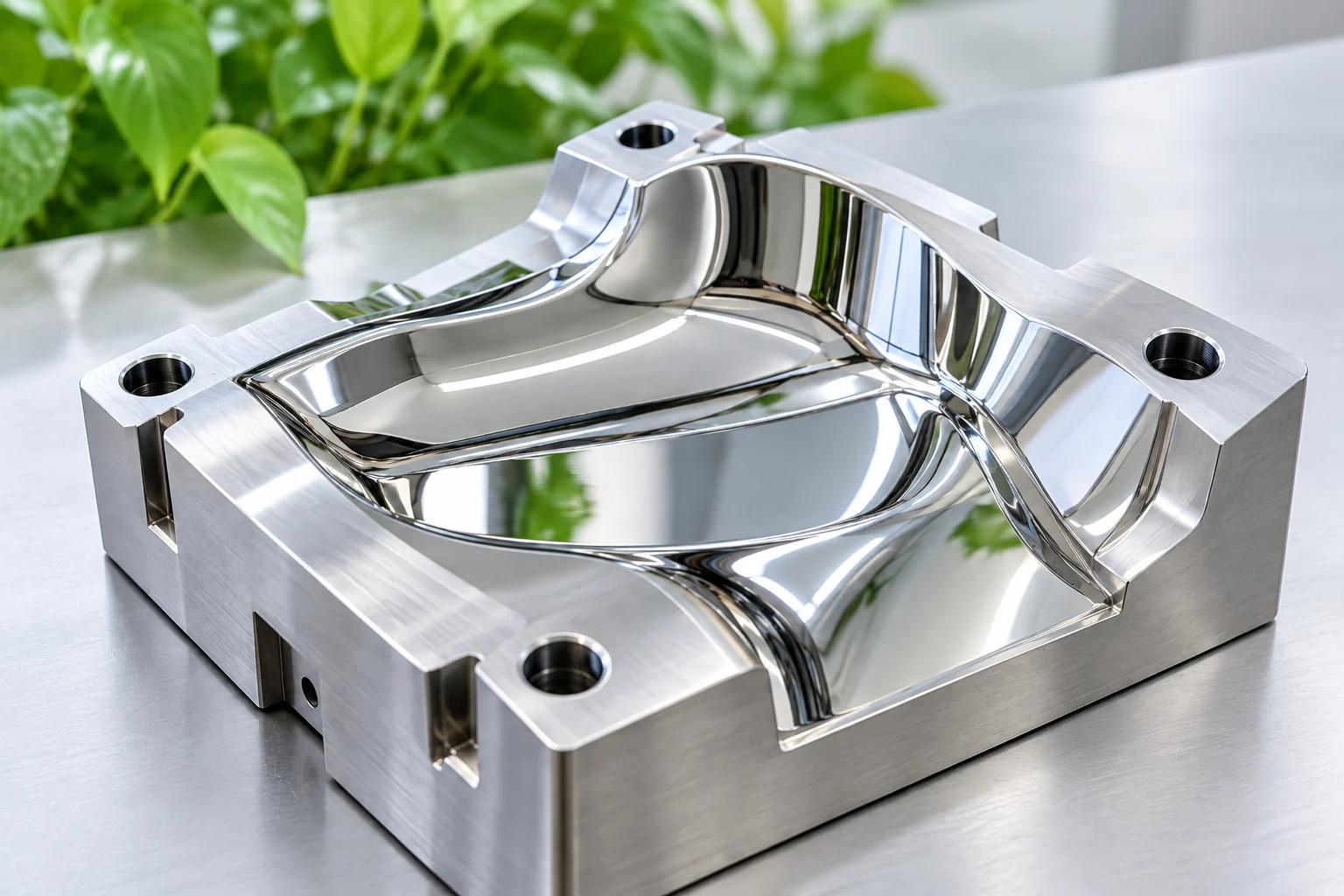
It is commonly considered for rotationally symmetric optical surfaces, precision molds, reflective components, aspheric profiles, and selected complex surfaces made from diamond-compatible materials.
However, SPDT is not suitable for every optical material or geometry. Material chemistry, tool path, component stiffness, interrupted features, required surface texture, and inspection requirements all influence whether diamond turning is the correct manufacturing process.
This guide explains how SPDT works, where it performs well, its limitations, and what engineers should consider before requesting a quotation.
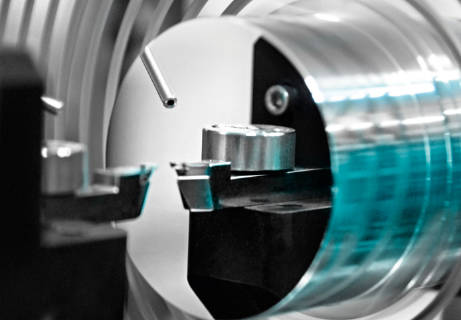
What Is Single Point Diamond Turning?
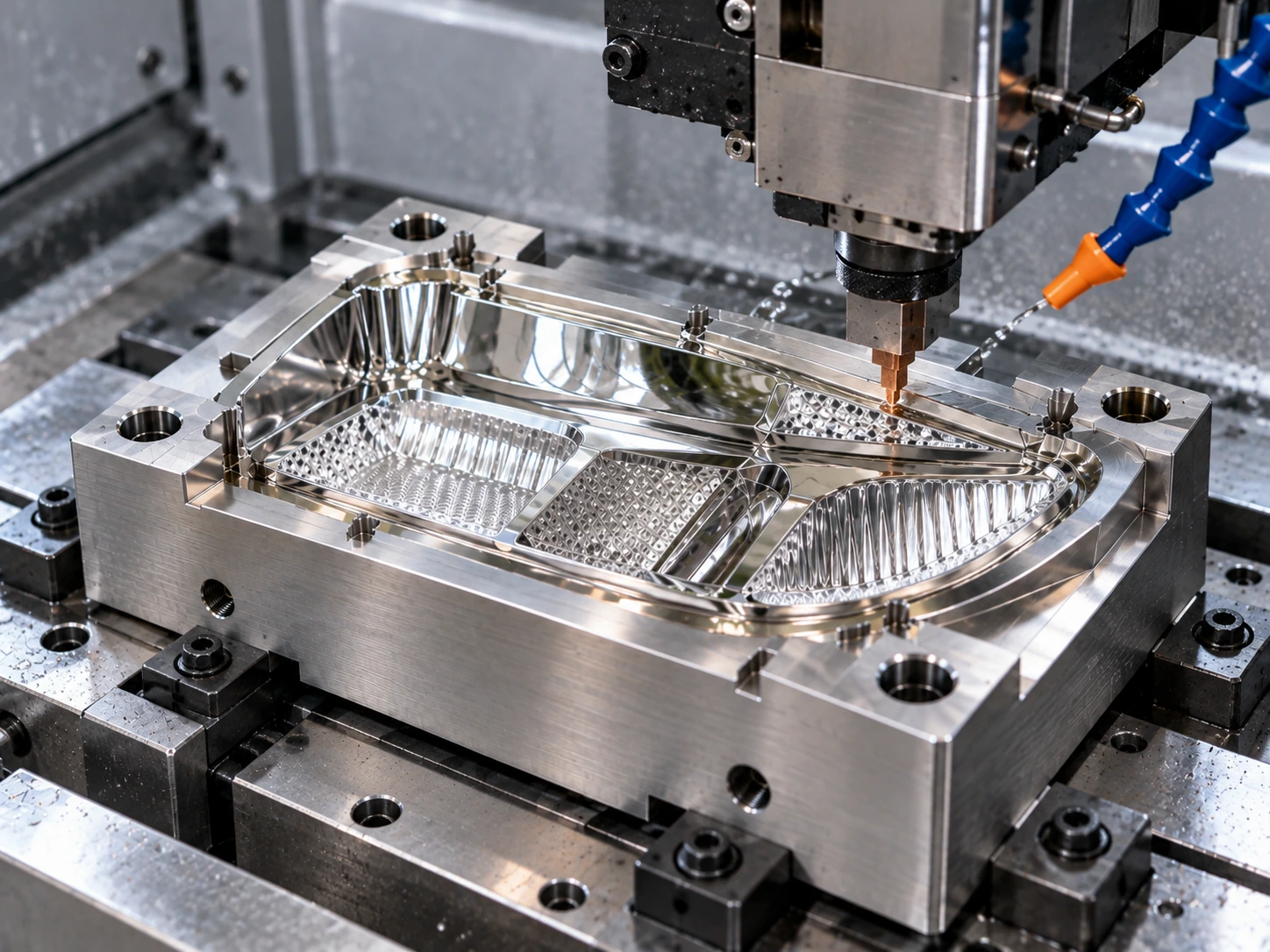
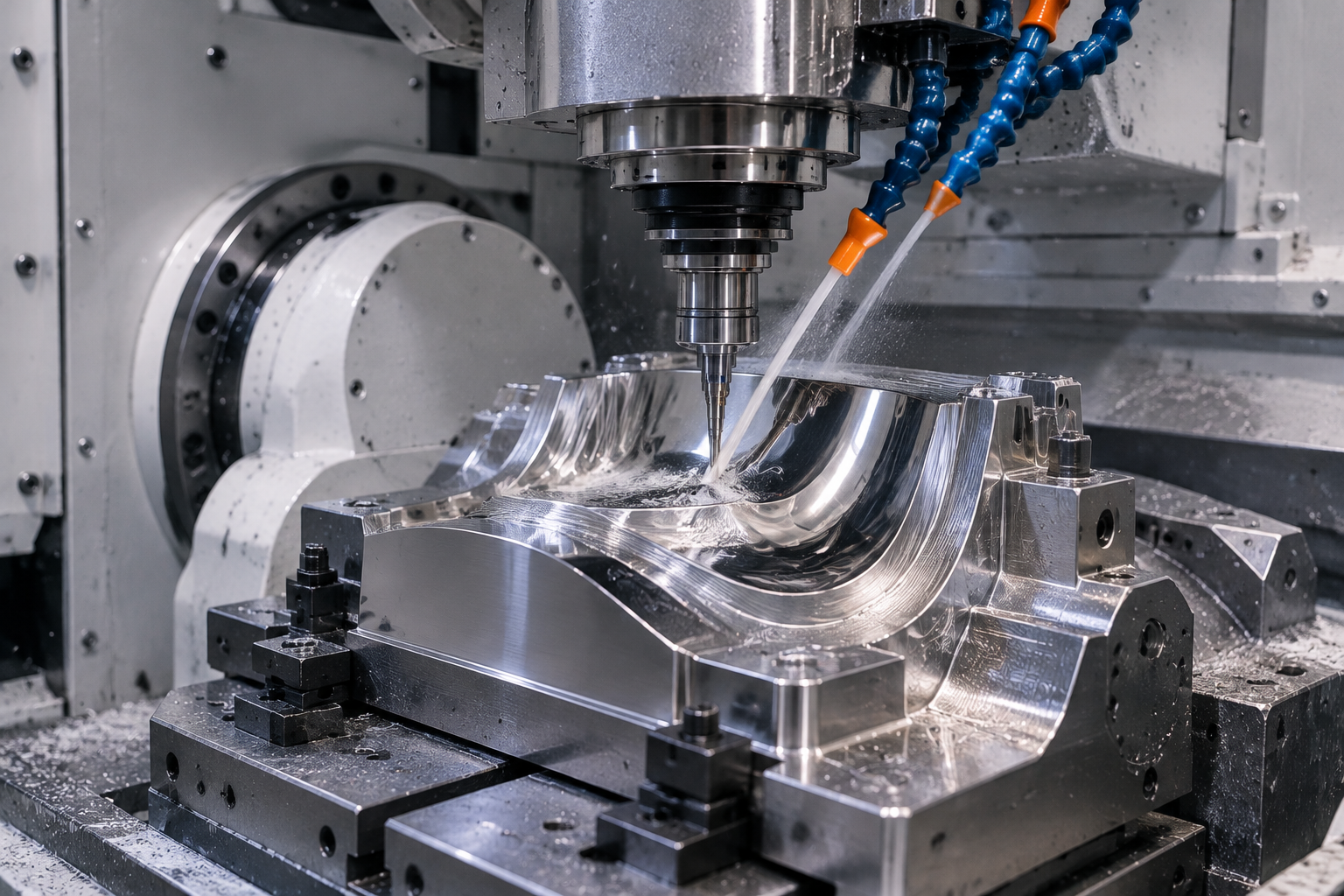
Single point diamond turning is an ultra-precision cutting process in which a diamond tool removes material from a workpiece using highly controlled relative motion.
In a conventional rotational SPDT setup:
- The workpiece is mounted to a precision spindle;
- The component rotates;
- A single diamond cutting edge moves across the surface;
- Small amounts of material are removed continuously;
- The programmed tool path generates the required optical profile.
The principle may resemble conventional CNC turning, but the scale of control is very different.
Ultra-precision machines typically rely on:
- High-accuracy spindle systems;
- Precision linear axes;
- High-resolution feedback;
- Thermal control;
- Vibration isolation;
- Carefully prepared diamond tooling;
- Precision fixturing;
- Controlled machining environments.
Machine manufacturers specializing in ultra-precision systems describe single-crystal diamond tooling as the standard approach when optical-quality cut surfaces are required on compatible materials. (Precitech)
YISHUN Optical also lists single-point diamond turning as part of its ultra precision machining services and publicly identifies diamond turning among its precision manufacturing technologies. (YISHUN Optical)
Why Is Diamond Used as the Cutting Tool?
Diamond combines several properties that are useful in ultra-precision cutting.
These include:
- Extremely high hardness;
- Very sharp achievable cutting edges;
- High wear resistance on compatible materials;
- Good edge stability;
- Ability to generate extremely small cutting radii.
The cutting edge can remove a very thin layer of material while maintaining a highly controlled tool geometry.
This helps reduce the large tool marks normally associated with conventional machining.
However, diamond hardness does not mean the tool can machine every material successfully.
Chemical compatibility between the tool and workpiece is just as important as hardness.
How SPDT Creates an Optical-Quality Surface
The final surface is generated by the combined movement of the workpiece and diamond tool.
Imagine a rotating circular part.
As the component spins, the diamond tool gradually moves across its radius. Instead of removing material randomly, the tool follows a mathematically defined trajectory.
The tool path can generate:
- Flat surfaces;
- Spherical surfaces;
- Aspheric surfaces;
- Parabolic profiles;
- Other rotationally symmetric profiles;
- Selected non-rotational forms when suitable servo technologies are available.
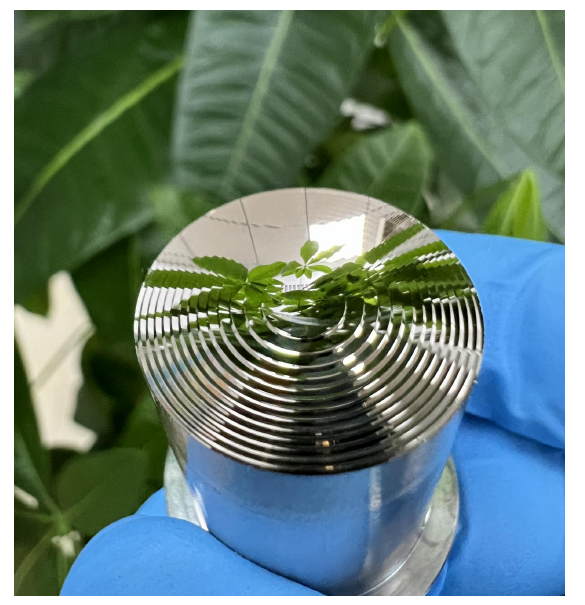
The final surface usually contains extremely fine periodic tool marks corresponding to tool feed and geometry.
These marks can become small enough that the surface appears mirror-like.
A diamond-turned surface is not perfectly featureless; its final texture is strongly influenced by tool geometry, feed rate, spindle behavior, material response, and machine stability.
This distinction matters when engineers evaluate surface roughness and optical performance.
Which Materials Are Suitable for Single Point Diamond Turning?
Material selection is one of the most important SPDT decisions.
Diamond turning works particularly well on many non-ferrous metals, selected crystalline materials, polymers, and specially prepared surfaces.
Common candidate material groups include:
Non-Ferrous Metals
Examples may include:
- Aluminum alloys;
- Copper;
- Brass;
- Selected nickel-phosphorus plated surfaces;
- Other compatible non-ferrous metals.
Optical and Engineering Polymers
Depending on the project, compatible polymers may include:
- PMMA;
- Polycarbonate;
- COC/COP materials;
- Other optical plastics.
Selected Crystalline Materials
Certain materials used in specialized optical systems can also be processed using carefully controlled diamond-machining strategies.
Ultra-precision machine manufacturer Precitech lists aluminum, brass, copper, plastics and several crystalline materials among materials commonly processed with single-crystal diamond tools. (Precitech)
What Materials Are More Difficult to Diamond Turn?
SPDT has important material limitations.
Some materials interact unfavorably with diamond and cause rapid tool wear.
Materials containing certain transition-metal elements can have strong chemical interaction with carbon at the cutting interface. This can degrade the diamond edge rapidly and make conventional SPDT impractical.
Traditional optical glass is another important case.
Many conventional glasses do not respond to diamond cutting in the same ductile manner as suitable metals and polymers. Brittle fracture and subsurface damage may make direct SPDT unattractive compared with grinding and polishing.
Precitech specifically notes that traditional optical glasses such as BK7 and fused silica are generally not considered good candidates for conventional single-point diamond cutting of finished optical surfaces. (Precitech)
Material compatibility should therefore be confirmed before designing a component around the SPDT process.
SPDT Material Selection at a Glance
| Material Group | General SPDT Suitability | Main Consideration |
| Aluminum alloys | Often suitable | Alloy structure and inclusions affect finish |
| Copper | Often suitable | Material purity and cutting conditions |
| Brass | Often suitable | Composition influences tool behavior |
| Nickel-phosphorus plated surfaces | Commonly suitable | Plating quality and phosphorus content matter |
| Optical polymers | Often suitable | Thermal response and deformation must be controlled |
| Selected crystalline materials | Application-dependent | Brittle-to-ductile cutting behavior |
| Traditional optical glass | Generally less suitable for conventional SPDT | Brittle fracture and subsurface damage |
| Materials with strong chemical interaction with diamond | Often difficult | Accelerated diamond-tool wear |
Actual manufacturability should always be evaluated using the exact material grade rather than the general material family.
What Shapes Can Single Point Diamond Turning Produce?
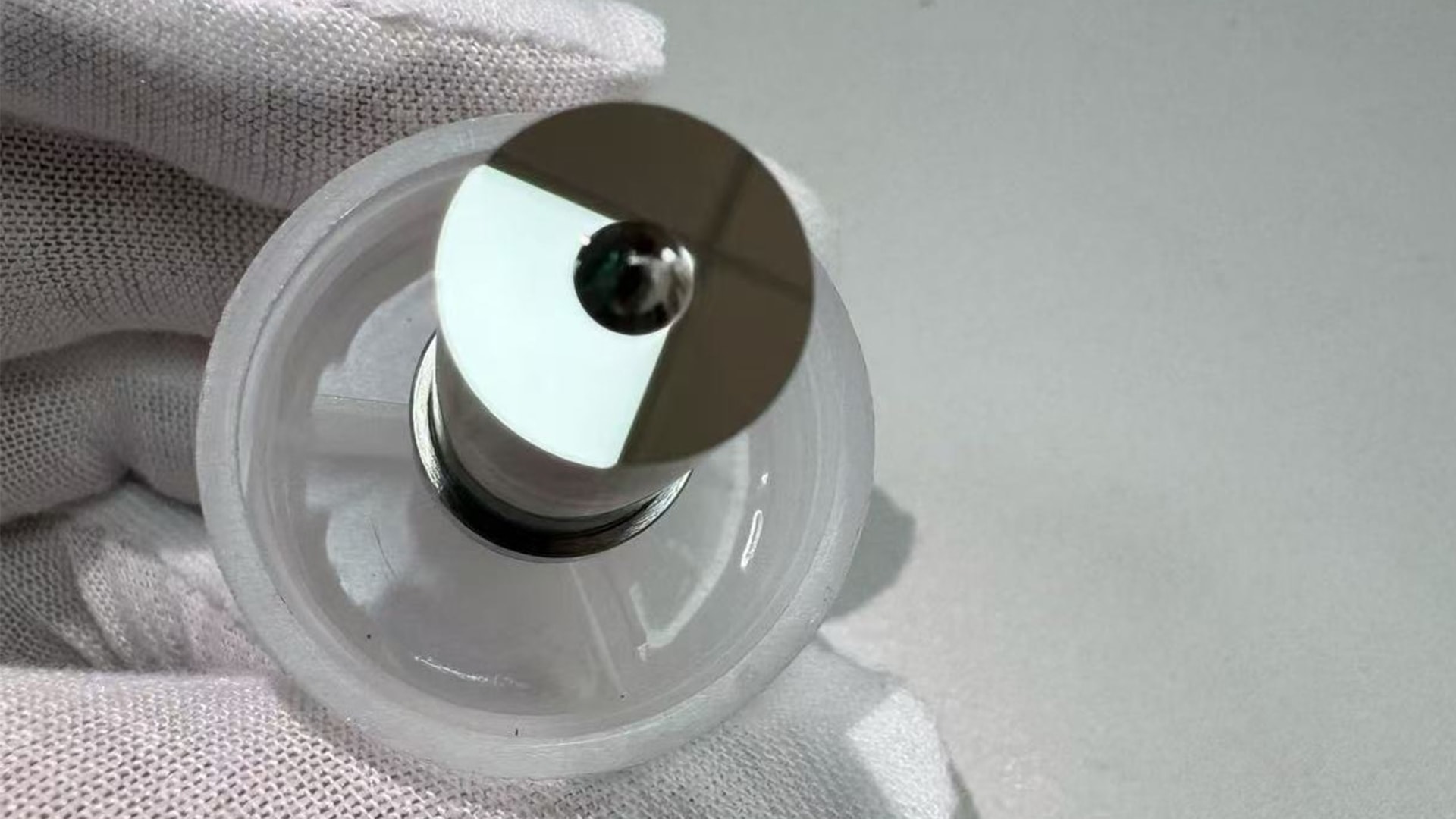
Classic SPDT is particularly efficient for rotationally symmetric parts.
Examples include:
- Flat discs;
- Spherical surfaces;
- Aspheric surfaces;
- Convex profiles;
- Concave profiles;
- Parabolic surfaces;
- Precision mold inserts.
Because the workpiece rotates around an axis, these geometries naturally match the machine kinematics.
Aspheric Surfaces
Aspheric surfaces are one of the most important uses of diamond turning.
Unlike a simple spherical surface, the curvature of an asphere changes across the radius.
With sufficiently accurate machine control, the diamond tool follows a programmed profile while the workpiece rotates.
This allows the aspheric surface to be generated directly rather than relying entirely on repeated corrective polishing.
Can SPDT Produce Freeform Surfaces?
Modern ultra-precision machines can extend beyond conventional rotationally symmetric turning.
Technologies such as:
- Fast Tool Servo;
- Slow Tool Servo;
- Multi-axis ultra-precision machining;
can introduce additional controlled tool motion.
This allows selected:
- Off-axis forms;
- Toroidal surfaces;
- Non-rotational features;
- Microstructures;
- Certain freeform surfaces.
Precitech has documented servo-assisted diamond-turning systems capable of generating non-rotationally symmetric surfaces with nanometer-scale finish under suitable conditions. (Precitech)
However, geometric complexity directly affects:
- Programming;
- Axis synchronization;
- Tool clearance;
- cycle time;
- Metrology;
- Surface-error control.
A surface being mathematically definable does not automatically mean SPDT is the most economical process.
Surface Roughness vs Form Accuracy
One of the most important SPDT concepts is that surface roughness and form accuracy are different specifications.
Surface Roughness
Surface roughness describes microscopic texture.
It can be affected by:
- Tool edge quality;
- Tool nose radius;
- Feed rate;
- Material microstructure;
- Vibration;
- Spindle behavior;
- Tool wear;
- Cutting parameters.
Form Accuracy
Form accuracy describes how closely the complete manufactured surface follows the intended mathematical geometry.
It can be affected by:
- Machine-axis accuracy;
- Thermal drift;
- Spindle error;
- Tool-position error;
- Fixture distortion;
- Calibration;
- Compensation strategy;
- Part deformation.
A part may therefore have:
- Excellent roughness but unacceptable form;
- Excellent form but excessive tool marks;
- Good values for both but localized defects.
A complete SPDT specification should separate surface roughness, form accuracy, dimensions and localized surface requirements rather than treating them as one general “mirror finish” requirement.
What Determines Diamond Turning Surface Finish?
Several variables have a direct effect on final surface condition.
| Process Variable | Potential Effect |
| Diamond tool quality | Influences cutting-edge stability and defects |
| Tool nose radius | Influences surface generation and tool marks |
| Feed rate | Affects spacing and height of periodic feed marks |
| Depth of cut | Influences cutting forces and material response |
| Spindle accuracy | Can introduce periodic surface errors |
| Vibration | May create chatter or surface modulation |
| Temperature | Can affect machine position and workpiece geometry |
| Material grain structure | Can create non-uniform cutting behavior |
| Tool wear | Can gradually increase roughness or defects |
| Fixturing | Can distort the component during cutting |
For this reason, surface finish should not be evaluated only by looking at the nominal machine specification.
The complete manufacturing system matters.
Why Thermal Stability Matters So Much
At ordinary machining tolerances, a small temperature change may have little practical effect.
At ultra-precision scales, thermal expansion can become significant.
Heat can come from:
- The spindle;
- Machine motors;
- The cutting process;
- Room-temperature variation;
- The workpiece;
- Operator handling.
Changes in temperature can shift:
- Tool position;
- Workpiece dimensions;
- Spindle geometry;
- Fixture geometry.
SPDT therefore benefits from tightly controlled machine and measurement environments.
Metrology should also be performed under appropriate conditions so that the measurement represents the actual finished component rather than temporary thermal distortion.
SPDT vs Conventional CNC Turning
The two processes share basic turning kinematics but operate at very different precision levels.
| Factor | Conventional CNC Turning | Single Point Diamond Turning |
| Tooling | Carbide and other conventional cutting tools | Precision diamond cutting tool |
| Primary goal | Dimensional machining | Ultra-precision form and surface generation |
| Machine control | Conventional precision | Ultra-precision motion control |
| Surface finish | Machined finish | Nanometer-scale finish possible on suitable projects |
| Environment | Normal controlled workshop | Stronger thermal and vibration control |
| Typical geometry | Mechanical turned parts | Precision optical and functional surfaces |
| Metrology | Conventional dimensional inspection | Dimensional plus advanced surface/form metrology |
SPDT should therefore not be treated as simply “more accurate CNC turning.”
The machining strategy, tooling, environment and inspection system are fundamentally more demanding.
SPDT vs Optical Polishing
Diamond turning and optical polishing can both produce highly refined surfaces, but they remove material differently.
| Factor | SPDT | Optical Polishing |
| Material removal | Defined diamond cutting edge | Abrasive or controlled finishing process |
| Geometry generation | Direct deterministic tool path | Progressive surface correction |
| Suitable materials | Material-dependent | Broader for many optical materials |
| Surface texture | Fine periodic cutting structure | Polishing-related texture |
| Complex form generation | Strong for suitable machined geometries | Depends on polishing technology |
| Tool marks | May remain from cutting path | Different surface artifacts may occur |
| Post-processing | Sometimes sufficient directly | Often used as final finishing |
For suitable materials and geometries, SPDT may generate both geometry and a high-quality finish within the same primary operation.
For other components, machining may establish the basic geometry and polishing may provide the final surface condition.
Does SPDT Always Eliminate Polishing?
No.
Some diamond-turned parts can meet their functional requirements directly from the machine.
Others may require further finishing because of:
- Surface-scatter requirements;
- Residual feed marks;
- Surface-defect requirements;
- Coating preparation;
- Form correction;
- Application-specific roughness targets.
The correct route therefore might be:
SPDT → Inspection → Finished Part
or:
SPDT → Surface Correction / Polishing → Final Inspection
Neither route is universally correct.
The decision should be based on the drawing and functional requirements.
Tool Marks and Surface Texture
A characteristic diamond-turned surface often contains a regular spiral texture created by the relationship between:
- Tool feed;
- Workpiece rotation;
- Tool geometry.
Reducing feed can reduce theoretical tool-mark height, but this may increase cycle time.
Tool geometry can also affect:
- Cusp height;
- Cutting forces;
- Edge stability;
- Accessible curvature.
This creates a practical engineering trade-off between:
- Surface quality;
- Production time;
- Tool life;
- Geometry.
The lowest possible feed is therefore not automatically the most economical production strategy.
Interrupted Surfaces Need Special Attention
SPDT generally performs most predictably when cutting remains continuous.
Features such as:
- Holes;
- Slots;
- Sharp interruptions;
- Discontinuous edges;
can cause the tool to repeatedly enter and leave the material.
Because diamond is extremely hard but can also be sensitive to impact at the cutting edge, interrupted geometry may increase the risk of:
- Edge damage;
- Surface ringing;
- Tool wear;
- Local defects.
Engineers should therefore identify interrupted features during manufacturability review rather than waiting until production.
Why Fixturing Matters
Ultra-precision machining can only produce an accurate free-state component if the part is held correctly.
Excessive clamping force can distort thin or compliant components.
The sequence can look like this:
- The part is clamped;
- Clamping slightly deforms the component;
- SPDT produces an apparently accurate surface;
- The part is released;
- The component returns toward its original shape;
- The measured surface no longer matches the machined condition.
Fixture design must therefore consider:
- Component stiffness;
- Wall thickness;
- Support location;
- Clamping force;
- Datum strategy;
- Vacuum holding where appropriate;
- Material behavior.
For thin and precision components, fixturing can be as important as the cutting program.
How Is a Diamond-Turned Part Inspected?
SPDT components may require several types of measurement.
Dimensional Inspection
Used to verify:
- Diameter;
- Thickness;
- Position;
- Datum relationships;
- Mechanical features.
Surface Roughness Measurement
Used to evaluate microscopic texture using an appropriate surface-metrology system.
Surface Form Measurement
Interferometric or other precision form-measurement methods may be used depending on component geometry and material.
Visual Surface Inspection
Used to identify:
- Scratches;
- Digs;
- Handling marks;
- Tool damage;
- Local defects.
The selected metrology should match the actual drawing specification.
YISHUN states that its precision manufacturing setup includes advanced dimensional and optical surface metrology and identifies SPDT as part of its ultra-precision machining capability. (YISHUN Optical)
When Does SPDT Make Sense for an Optical Component?
SPDT becomes a strong candidate when several of the following conditions are present:
- Material is diamond-turnable;
- Geometry suits turning or servo-assisted turning;
- Very smooth machined surfaces are required;
- Tight form control is important;
- Aspheric or controlled mathematical profiles are required;
- Direct machining could reduce subsequent finishing;
- Repeatability between components is important.
Alternative processes may be more appropriate when:
- Material does not respond well to diamond cutting;
- Geometry contains extensive inaccessible features;
- Surface interruptions create unacceptable tool risk;
- The final requirement depends primarily on a polishing process;
- Part stiffness makes precision turning difficult.
A Practical SPDT Selection Checklist
| Question | If Yes | Why It Matters |
| Is the material diamond-compatible? | Continue SPDT evaluation | Material chemistry is a fundamental limitation |
| Is the surface rotationally symmetric? | SPDT is a strong candidate | Matches standard turning kinematics |
| Is the surface a controlled asphere? | SPDT may be highly suitable | Direct profile generation is possible |
| Is the component freeform? | Review servo or multi-axis capability | Standard SPDT may not be sufficient |
| Are there holes or interruptions in the cutting area? | Require manufacturability review | Tool impact and surface artifacts may increase |
| Is nanometer-scale roughness required? | Evaluate exact material and process | Surface result is material-dependent |
| Is the part very thin? | Review fixture strategy | Clamping distortion may affect form |
| Is additional polishing acceptable? | Hybrid route may be possible | Can extend achievable surface performance |
What Should You Include in an SPDT RFQ?
A useful single point diamond turning RFQ should include:
- Material and exact grade;
- 2D drawing;
- 3D model where relevant;
- Part dimensions;
- Required geometry;
- Surface definition;
- Surface roughness;
- Form tolerance;
- Dimensional tolerance;
- Critical optical area;
- Quantity;
- Prototype and projected production quantity;
- Incoming material condition;
- Coating requirement if relevant;
- Inspection requirements;
- Required measurement reports.
If the surface is mathematically defined, provide the correct equation or digital surface data.
Avoid vague requirements such as:
Ultra-smooth mirror surface.
Instead, specify measurable acceptance criteria.
How to Evaluate a Single Point Diamond Turning Supplier
When sourcing SPDT services, ask the supplier:
- Does it have direct experience with the exact material?
- Which machine configuration is proposed?
- Is the geometry suitable for conventional turning or does it need additional axis control?
- How will the component be fixtured?
- How will surface roughness be verified?
- How will form accuracy be measured?
- Are interrupted features a concern?
- Is post-processing recommended?
- How will prototype parameters transfer to repeat production?
- What information will appear on the inspection report?
A strong supplier should be able to explain the relationship between the material, geometry, tool path, surface requirement and inspection strategy.
YISHUN Optical publicly lists single-point diamond turning within its ultra precision machining capabilities, alongside other precision machining technologies. Its website also identifies ultra-precision machining for consumer electronics, automotive, medical, new-energy and industrial applications. (YISHUN Optical)
More company and processing information is available through the YISHUN Optical website.
FAQ
What is single point diamond turning?
Single point diamond turning is an ultra-precision machining process that uses a precision diamond cutting tool to generate highly controlled surfaces on compatible materials. The workpiece commonly rotates while the tool follows a programmed surface profile.
What is SPDT used for?
SPDT is commonly used for precision optical surfaces, aspheric components, reflective components, mold inserts, precision substrates and other parts requiring highly controlled form and very low surface roughness.
What materials can be single point diamond turned?
Common candidates include aluminum, copper, brass, selected plated surfaces, optical polymers and certain crystalline materials. Exact suitability depends on material grade and required surface performance.
Can optical glass be diamond turned?
Traditional optical glasses are generally less suitable for conventional SPDT because brittle fracture and subsurface damage can occur. Grinding and polishing are often more appropriate, although specialized machining techniques exist for selected materials.
What surface roughness can diamond turning achieve?
Nanometer-scale surface roughness is possible on suitable materials under controlled conditions. The achievable value depends on material, tool condition, machine stability, feed, geometry and measurement method.
Can SPDT machine aspheric optical surfaces?
Yes. Rotationally symmetric aspheric surfaces are a common application because the diamond tool can follow a programmed mathematical profile while the component rotates.
Can single point diamond turning produce freeform surfaces?
Selected non-rotational surfaces can be produced using additional technologies such as Fast Tool Servo, Slow Tool Servo or appropriate multi-axis systems. Geometry must be evaluated individually.
Does diamond turning require polishing afterward?
Not always. Some parts can meet final requirements directly after SPDT. Other components require polishing or additional surface correction to meet stricter roughness, form or surface-quality requirements.
What is the difference between diamond turning and normal CNC turning?
SPDT uses precision diamond tooling, ultra-precision machine motion, stronger thermal and vibration control, specialized fixturing and advanced metrology to generate much finer surfaces and more accurate forms than conventional turning.
What information is needed for a diamond turning quote?
Provide the material, drawing, 3D model where relevant, surface geometry, dimensions, roughness, form tolerance, quantity, critical surface, incoming condition and inspection requirements.
Conclusion
Single point diamond turning is a powerful ultra-precision manufacturing process when the material, component geometry and surface requirements are compatible with diamond cutting.
Its value lies in combining deterministic surface generation with extremely fine material removal.
For rotationally symmetric components and suitable aspheric surfaces, SPDT can generate highly controlled geometry directly from a mathematical tool path. Servo-assisted and multi-axis technologies can extend the process to selected more complex surfaces.
However, successful SPDT depends on more than machine resolution.
Material chemistry, diamond-tool condition, thermal stability, vibration, feed rate, fixturing, tool path and metrology all influence the final component.
The correct question is therefore not simply whether a part can be diamond turned, but whether SPDT is the most appropriate process for its material, geometry, surface specification and production requirements.
Engineers evaluating a new component can review YISHUN Optical’s single point diamond turning and ultra precision machining services and submit drawings for project-specific manufacturability review.