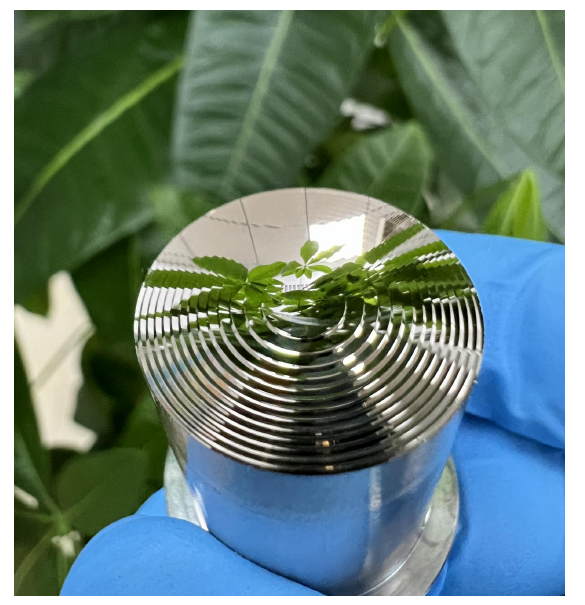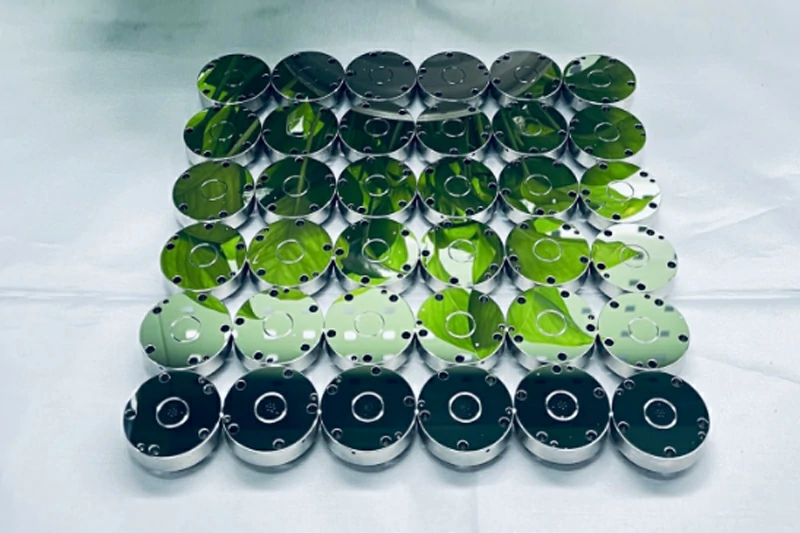
Diamond turning, grinding, and polishing are not three interchangeable ways to achieve the same result. They perform different jobs in precision optical manufacturing.
Diamond turning is often the strongest option for generating high-accuracy optical surfaces directly on diamond-compatible materials. Grinding is better suited to efficient material removal and geometry generation, particularly on hard or brittle materials. Polishing is primarily used to achieve the final surface roughness, surface quality, and corrective finish after the basic geometry has already been established.
For many optical parts, the right answer is therefore not choosing one process.
It is choosing the correct process sequence.
A component may be diamond turned directly to its final requirement, while another may require grinding followed by polishing. A third may use precision machining first and then a controlled polishing step to remove residual surface texture.
This guide compares diamond turning vs grinding vs polishing from the perspectives of material compatibility, geometry, surface finish, accuracy, production efficiency, and sourcing.
The Short Answer: Which Process Should You Choose?
Use this as an initial engineering guide:
| Requirement | Likely Process Choice |
| Diamond-compatible rotationally symmetric part | Diamond turning |
| Direct generation of an aspheric profile | Diamond turning |
| Hard or brittle optical material | Precision grinding |
| Large amount of material must be removed | Grinding |
| Very low final surface roughness | Polishing |
| Fine-ground optical glass surface | Polishing after grinding |
| Flatness or geometry needs major correction | Grinding or lapping before polishing |
| Existing geometry is already accurate but surface finish is insufficient | Polishing |
| Complex process requiring both geometry and final finish | Grinding + polishing |
| Compatible material requiring direct optical-quality machining | Diamond turning, with post-processing if required |
The correct process should be chosen according to material, geometry, stock removal, form accuracy, roughness, and final surface requirements—not simply according to which technology sounds more precise.
First Understand What Each Process Actually Does
The easiest way to compare the three processes is to look at their primary manufacturing function.
Diamond Turning: Generate the Final Surface with a Cutting Tool
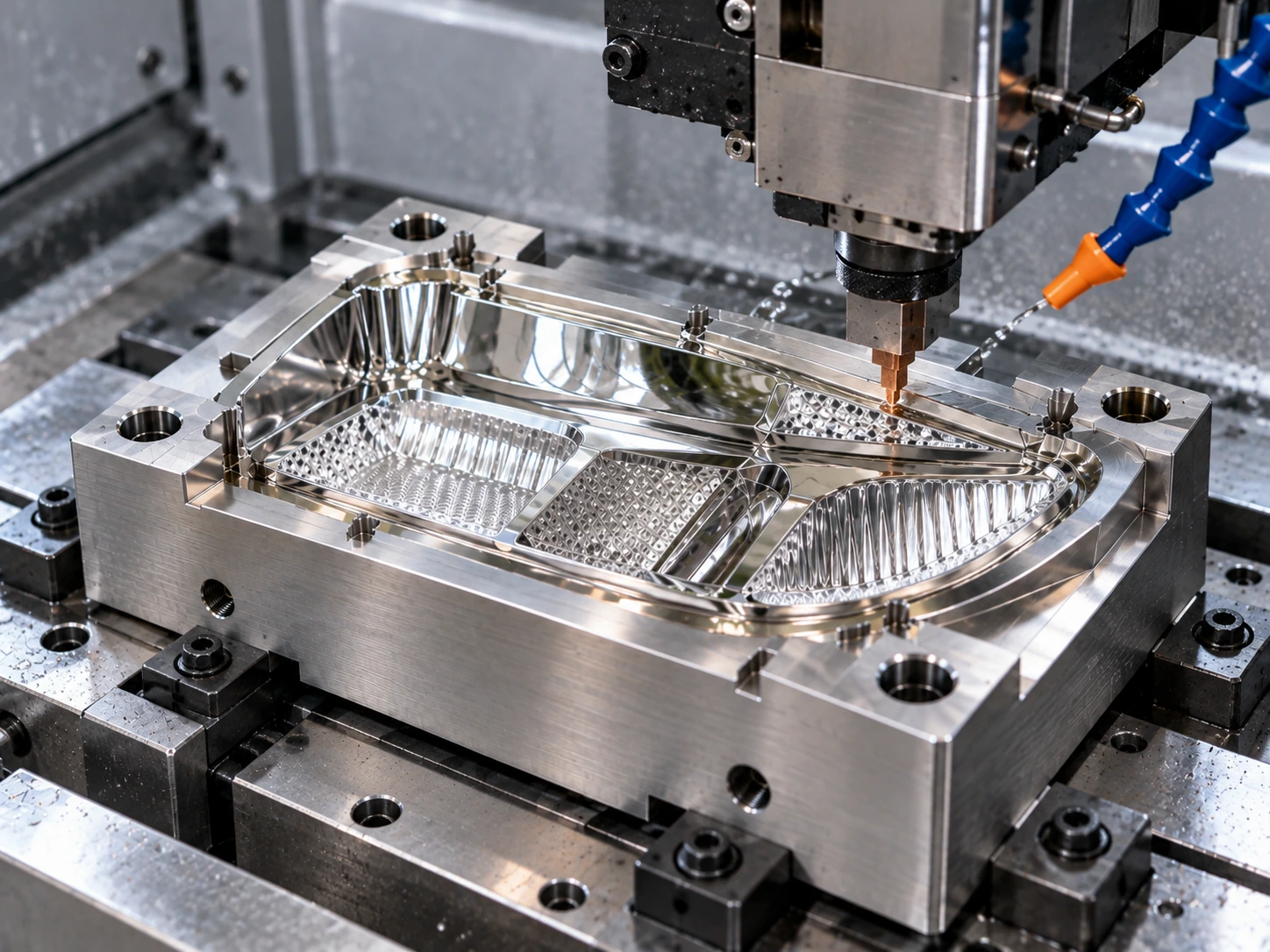
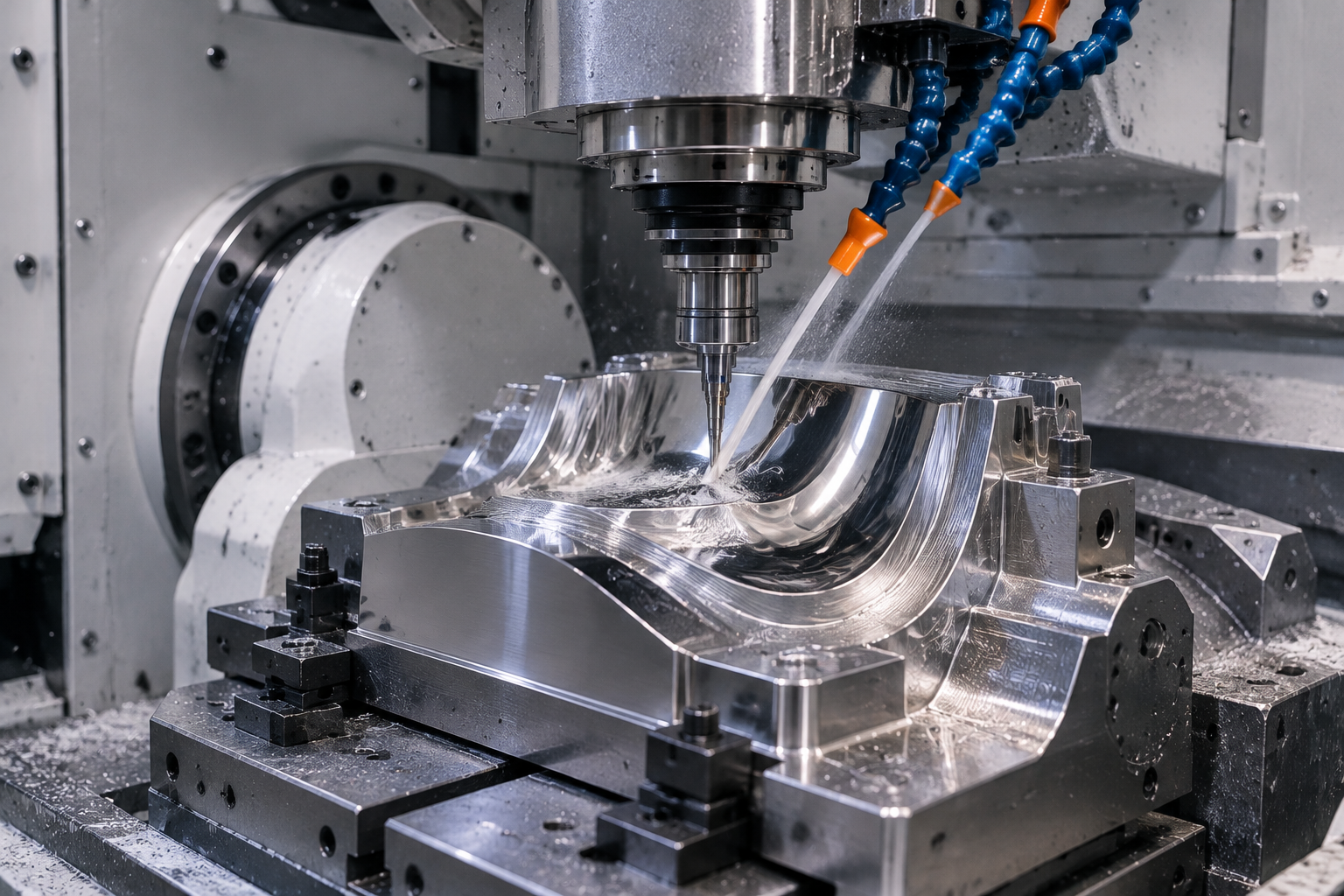
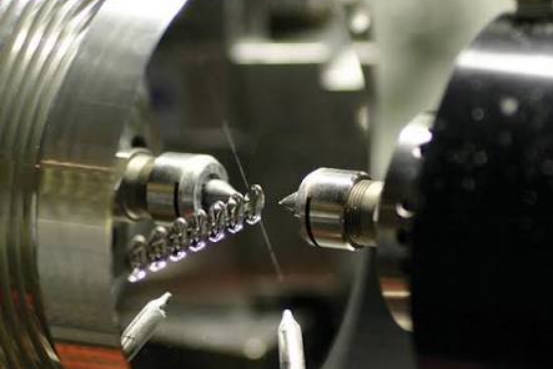
Single point diamond turning uses an extremely sharp diamond tool to remove material from a rotating workpiece under ultra-precise machine control.
The cutting tool follows a programmed path that directly generates the required surface.
It can be particularly effective for:
- Flats;
- Spheres;
- Aspheres;
- Concave surfaces;
- Convex surfaces;
- Precision mold surfaces;
- Selected non-rotational profiles using appropriate machine configurations.
Because the cutting action is deterministic, geometry and surface finish can sometimes be created during the same machining operation.
Grinding: Generate Geometry with Abrasive Material Removal
Grinding uses abrasive particles bonded into a wheel or grinding tool.
Instead of a single cutting edge, many abrasive grains remove material from the component.
Precision optical grinding may be used for:
- Rough geometry generation;
- Fine geometry correction;
- Removing substantial stock;
- Producing spherical or aspheric surfaces;
- Preparing hard or brittle components for polishing.
Grinding normally produces a surface that is more refined than rough machining but not necessarily ready for final optical use.
Polishing: Refine the Final Surface
Polishing usually removes much smaller amounts of material than grinding.
The process may use:
- Fine abrasive slurry;
- Polishing pads;
- Compliant tools;
- Controlled sub-aperture tools;
- Other deterministic finishing systems.
Its main function is not rapid bulk material removal.
It is to improve:
- Surface roughness;
- Surface defects;
- Final surface form;
- Local error;
- Optical clarity;
- Reflective surface quality.
Diamond Turning vs Grinding vs Polishing at a Glance
| Factor | Diamond Turning | Precision Grinding | Optical Polishing |
| Material-removal mechanism | Single diamond cutting edge | Bonded abrasive grains | Fine abrasive / controlled finishing |
| Removal rate | Moderate | High to moderate | Low |
| Main purpose | Direct geometry and fine surface generation | Geometry generation and stock removal | Final surface refinement |
| Surface finish | Very fine on suitable materials | Fine-ground condition | Very fine |
| Form generation | Excellent for suitable geometries | Excellent | Mainly correction/refinement |
| Hard brittle materials | Material-dependent | Strong option | Common final step |
| Rotational symmetry | Excellent | Excellent | Suitable |
| Freeform capability | Machine-dependent | Strong with multi-axis systems | Strong with appropriate polishing technology |
| Tool marks | Fine deterministic marks may remain | Grinding marks / subsurface damage possible | Polishing texture may remain |
| Bulk material removal | Not primary strength | Strong | Inefficient |
| Final finishing | Sometimes unnecessary | Usually requires further finishing | Often final process |
When Diamond Turning Is the Better Choice
Diamond turning becomes attractive when material and geometry are both compatible with the process.
1. The Material Responds Well to Diamond Cutting
Common candidate materials can include:
- Aluminum alloys;
- Copper;
- Brass;
- Selected plated surfaces;
- Optical polymers;
- Certain crystalline materials.
Material grade matters.
Even within one material family, grain structure, inclusions, hardness, and manufacturing history can affect the final diamond-turned surface.
2. The Geometry Is Rotationally Symmetric
Classic single point diamond turning naturally favors surfaces generated around a rotational axis.
Examples include:
- Spherical surfaces;
- Aspheres;
- Parabolic profiles;
- Circular flats;
- Concave optical surfaces;
- Convex optical surfaces.
This geometric match allows the machine to use continuous controlled tool motion.
3. Direct Surface Generation Is Valuable
For compatible parts, diamond turning can sometimes produce a surface that already meets the final roughness and form requirement without a separate polishing operation.
That can reduce:
- Handling;
- Re-fixturing;
- Process steps;
- Alignment changes;
- Total cycle time.
The main advantage of diamond turning is its ability to combine deterministic form generation and very fine surface creation within one machining process on suitable materials.
When Diamond Turning Is Not the Right Process
SPDT has clear limitations.
Material Compatibility
Traditional optical glasses are generally more challenging for conventional diamond cutting.
Instead of being removed entirely through controlled ductile cutting, brittle materials may develop:
- Microfractures;
- Surface damage;
- Subsurface damage.
These materials are commonly better suited to precision grinding followed by polishing.
Material Chemistry
Certain material chemistries can also produce excessive diamond tool wear.
The fact that diamond is extremely hard does not mean it is compatible with every workpiece.
Interrupted Features
Holes, slots, and discontinuous edges can cause repeated tool entry and exit.
Because the diamond cutting edge is very hard but sensitive to impact conditions, interrupted cutting requires careful engineering review.
Complex Non-Rotational Geometry
Advanced machine systems can extend diamond machining to selected freeform surfaces, but not every three-dimensional component is well suited to conventional SPDT.
When Precision Grinding Is the Better Choice
Grinding occupies a different position in the manufacturing chain.
It becomes particularly useful when substantial material still needs to be removed.
Hard and Brittle Materials
Precision grinding is widely used to generate optical surfaces from materials that are difficult to cut using conventional single-point tools.
Grinding allows controlled abrasive interaction with the workpiece.
Large Form Corrections
Suppose a blank must eventually become a curved optical component.
It would be inefficient to use a final polishing process to remove all the material needed to create that shape.
Grinding can establish:
- Radius;
- Aspheric departure;
- Freeform geometry;
- Thickness;
- Basic surface form.
The part can then move into finer finishing stages.
Preparing a Stable Surface for Polishing
An effective optical manufacturing process attempts to leave polishing with as little unnecessary correction work as possible.
The better the fine-ground geometry, the less material polishing has to remove.
This can improve:
- Cycle time;
- Form stability;
- Process predictability.
Why Grinding Usually Comes Before Polishing
Imagine that a component has 100 units of unwanted material or geometry error.
Grinding might efficiently remove the first 90 or more units.
Polishing then removes the small remaining amount while improving the surface.
Trying to use polishing for all 100 units would generally be inefficient.
This is why optical manufacturing commonly follows a progression such as:
Raw Blank
↓
Geometry Generation
↓
Precision Grinding
↓
Metrology
↓
Fine Grinding / Correction
↓
Polishing
↓
Final Metrology
Grinding should establish the geometry as efficiently as possible; polishing should refine the surface rather than compensate for avoidable bulk-form errors.
YISHUN Optical combines several processes within its ultra precision machining services, allowing the manufacturing route to be selected according to material, geometry, and surface requirements.
When Polishing Is the Better Choice
Polishing becomes critical when the geometry is already close to the final requirement but the surface condition is not.
Reducing Surface Roughness
Fine grinding still leaves microscopic surface texture.
Polishing progressively reduces these surface irregularities.
Depending on the application, this can improve:
- Optical clarity;
- Specular reflection;
- Surface uniformity;
- Coating preparation;
- Surface quality.
Removing Fine Processing Damage
Grinding can leave a near-surface damaged layer.
A controlled polishing process can remove the remaining affected material while refining the final surface.
Correcting Residual Form Error
Modern deterministic polishing is not limited to uniformly making a surface smoother.
When combined with metrology, controlled polishing can selectively remove material from higher-error areas.
The process becomes:
Measure
↓
Generate an error map
↓
Calculate corrective removal
↓
Polish selected areas
↓
Measure again
This metrology-driven correction is especially valuable for demanding surface-form requirements.
Diamond Turning vs Polishing: The Main Difference
The search phrase diamond turning vs polishing often suggests that the two processes are alternatives.
Sometimes they are.
Often they are not.
Diamond turning is a cutting and surface-generation process.
Polishing is a surface-refinement and corrective finishing process.
Choose Diamond Turning When:
- Material is suitable for diamond machining;
- Geometry fits the turning strategy;
- Direct form generation is required;
- Reducing post-processing is valuable;
- A deterministic tool path can create the final profile.
Choose Polishing When:
- Surface geometry already exists;
- Roughness must be reduced further;
- Fine grinding marks need removal;
- Residual surface form must be corrected;
- Material is better suited to abrasive finishing;
- Final surface quality is more important than material-removal rate.
Use Both When:
A diamond-turned surface meets the basic geometry requirement but additional surface refinement is still needed.
Diamond turning can sometimes eliminate polishing, but polishing remains valuable when the final specification exceeds what the directly machined surface can provide.
Diamond Turning vs Grinding: The Main Difference
The comparison between diamond turning vs grinding is more strongly influenced by material and geometry.
Diamond Turning
Uses one accurately defined cutting edge.
Its strength is precise deterministic surface generation on compatible materials.
Grinding
Uses many abrasive cutting points.
Its strength is controlled material removal across a broader range of hard and brittle materials.
| Decision Factor | Diamond Turning | Grinding |
| Diamond-compatible soft material | Strong choice | Possible but may not be necessary |
| Hard brittle material | More limited | Strong choice |
| Direct optical-level machined finish | Possible | Usually not the final step |
| Large stock removal | Moderate | Better suited |
| Rotational asphere | Strong | Strong |
| Surface ready for polishing | Sometimes already beyond this stage | Common output |
| Tool wear sensitivity | Material chemistry important | Wheel condition important |
Grinding vs Polishing: Why They Are Usually Sequential
Grinding and polishing are often described together because they commonly appear in the same manufacturing route.
However, their objectives are different.
Grinding prioritizes:
- Shape;
- Material removal;
- Dimensional preparation;
- Surface generation.
Polishing prioritizes:
- Roughness;
- Surface quality;
- Fine form correction;
- Final optical finish.
A useful engineering rule is:
Do not ask polishing to solve a problem that should have been solved during grinding.
If a component reaches polishing with excessive form error or too much remaining stock, finishing time can increase significantly.
Which Process Produces the Lowest Surface Roughness?
There is no universal answer independent of material, geometry, equipment, measurement method, and process conditions.
Both diamond turning and precision polishing can produce extremely smooth surfaces under appropriate conditions.
Diamond turning may provide an exceptionally smooth directly machined finish on compatible materials.
Polishing remains the traditional final route for many optical glasses and other materials where abrasive finishing is more suitable.
Grinding generally produces a rougher surface than the final two processes because its primary purpose is material and geometry removal.
A better comparison is:
| Process | Relative Surface Stage |
| Rough grinding | Geometry generation |
| Fine grinding | Pre-polish surface |
| Diamond turning | Potential final surface on suitable materials |
| Precision polishing | Final surface refinement |
Which Process Gives Better Form Accuracy?
Again, the answer depends on the complete manufacturing system.
Diamond turning provides highly deterministic geometry because tool position directly determines the generated surface.
Precision grinding can also generate highly accurate surfaces, especially when combined with metrology-driven correction.
Polishing can further improve form, but excessive polishing can also change geometry if material removal is not controlled.
Final form accuracy therefore depends on:
- Machine accuracy;
- Tool condition;
- Fixture design;
- Thermal stability;
- Material behavior;
- Process parameters;
- Metrology;
- Correction strategy.
The process name alone does not determine the result.
Geometry Changes the Decision
Different geometries favor different process routes.
Rotationally Symmetric Parts
Diamond turning is attractive when the material is compatible.
Grinding and polishing remain strong alternatives for other materials.
Aspheric Surfaces
All three processes may play a role.
A diamond-compatible asphere may be directly turned.
Other aspheres may be:
Grinding
→ Fine Grinding
→ Polishing
→ Corrective Polishing
Freeform Surfaces
Multi-axis grinding and deterministic polishing provide strong flexibility.
Advanced ultra-precision machining systems can also machine selected freeform geometries directly.
Flat Parts
The manufacturing route depends heavily on:
- Flatness;
- Parallelism;
- Thickness;
- Roughness;
- Material.
Grinding or lapping may establish geometry before polishing.
Material Should Be the First Filter
Before comparing surface finish, first ask:
Can this material be processed efficiently by the proposed method?
A practical starting matrix looks like this:
| Material Type | Typical Process Direction |
| Diamond-compatible non-ferrous metal | Diamond turning may be considered |
| Compatible optical polymer | Diamond turning may be considered |
| Traditional optical glass | Grinding + polishing commonly considered |
| Hard ceramic | Grinding followed by suitable finishing |
| Precision plated optical surface | Diamond turning may be considered depending on coating |
| Difficult hard material | Grinding route often evaluated first |
These are process-selection directions rather than universal rules.
Exact grade, geometry, dimensions, and final specification still need engineering review.
Cost: Which Process Is Cheaper?
Comparing machine-hour rates alone can be misleading.
The real comparison should be total cost to reach the accepted finished part.
Consider a compatible rotationally symmetric part.
Route A:
Diamond Turning
→ Inspection
Route B:
Grinding
→ Cleaning
→ Inspection
→ Polishing
→ Cleaning
→ Final Inspection
Even if diamond-turning equipment has a higher hourly cost, Route A may have fewer total operations.
But for a material poorly suited to diamond cutting, forcing Route A may create:
- Tool wear;
- Surface defects;
- Low yield;
- Additional rework.
Route B may then be substantially more economical.
Cost Drivers
| Cost Driver | Diamond Turning | Grinding | Polishing |
| Machine setup | Important | Important | Important |
| Tooling | Diamond tool | Grinding wheel/tool | Pads/tools/slurry |
| Cycle time | Geometry-dependent | Stock-dependent | Surface-spec dependent |
| Material sensitivity | High | Moderate | High |
| Metrology | Critical | Critical | Critical |
| Rework risk | Material/process dependent | Surface damage dependent | Over-correction dependent |
| Quantity | Affects setup allocation | Affects setup allocation | Affects process strategy |
The Hybrid Process Is Often the Real Answer
Engineers sometimes search for the “best” process as if only one technology can be used.
In practice, advanced optical manufacturing is often a process chain.
Route 1: Diamond Turning Only
Suitable material
→ SPDT
→ Inspection
Useful when the directly machined surface meets all requirements.
Route 2: Grinding + Polishing
Blank
→ Rough Grinding
→ Fine Grinding
→ Metrology
→ Polishing
→ Final Inspection
Common when abrasive processing is better suited to the material.
Route 3: Precision Machining + Polishing
Precision Machining
→ Metrology
→ Local Surface Correction
→ Final Polishing
→ Inspection
Useful when machining establishes geometry but the final surface needs further refinement.
YISHUN Optical’s ultra precision machining capabilities include multiple precision manufacturing processes, allowing engineering evaluation to focus on the required finished component rather than forcing every design into one manufacturing method.
Six Questions That Determine the Right Process
Before selecting a manufacturing route, answer these questions in order.
1. What Is the Material?
This immediately eliminates unsuitable processes.
2. How Much Material Must Be Removed?
Large stock removal usually favors grinding over polishing.
3. What Geometry Must Be Generated?
Rotational symmetry, freeform surfaces, and interrupted features require different strategies.
4. What Surface Roughness Is Required?
The final roughness determines whether the machined or ground surface needs additional finishing.
5. What Form Accuracy Is Required?
Tighter form specifications may require metrology-driven correction.
6. What Is the Production Volume?
Prototype and repeat production can favor different process economics.
Common Process-Selection Mistakes
Choosing Diamond Turning Only Because It Sounds More Precise
SPDT is powerful, but material compatibility comes first.
Using Polishing for Excessive Stock Removal
Polishing is a finishing process. Large geometry changes should normally be handled earlier.
Assuming Grinding Is Only a Rough Process
Modern precision grinding can produce highly controlled geometry and can be an essential part of ultra-precision manufacturing.
Specifying “Mirror Finish” Without Numerical Requirements
A visual description does not define:
- Surface roughness;
- Form accuracy;
- Surface defects.
Ignoring Subsurface Condition
The visible surface does not always reveal damage left by earlier manufacturing stages.
Selecting the Process Before Finalizing the Functional Requirements
The drawing should primarily specify the finished component.
Manufacturing engineers can then select the appropriate process route.
What Should You Include in Your RFQ?
For accurate process selection, provide:
- Material and exact grade;
- 2D drawing;
- 3D model where relevant;
- Overall dimensions;
- Incoming condition;
- Quantity;
- Critical surfaces;
- Surface roughness;
- Surface form tolerance;
- Flatness;
- Parallelism where relevant;
- Surface-quality requirement;
- Required inspection method;
- Prototype quantity;
- Expected repeat-production quantity.
Instead of writing:
Diamond turn this part.
consider writing:
Please evaluate the appropriate ultra-precision process to achieve the drawing requirements.
This allows the supplier to consider diamond turning, grinding, polishing, or a combined route.
How to Evaluate an Ultra Precision Machining Supplier
A strong supplier should be able to answer:
- Why is the proposed process suitable for the material?
- Which step establishes the basic geometry?
- Which step determines final surface roughness?
- Will the component require multiple setups?
- How will datum relationships be maintained?
- How will surface form be measured?
- How will roughness be measured?
- Is post-machining polishing necessary?
- What specifications are the primary cost drivers?
- Can the same process be repeated in production?
A supplier that offers multiple ultra precision machining processes can evaluate the complete route rather than treating one process as the answer to every optical component.
For additional company and manufacturing information, engineers can review YISHUN Optical.
FAQ
What is the difference between diamond turning and polishing?
Diamond turning generates geometry by cutting a suitable material with a precision diamond tool. Polishing removes much smaller amounts of material to reduce roughness, remove fine surface defects, and correct residual form error.
Can diamond turning replace optical polishing?
Sometimes. On compatible materials, a diamond-turned surface may meet the final surface and form requirements directly. Other parts still require polishing because of roughness, surface-texture, form, or application requirements.
What is the difference between diamond turning and grinding?
Diamond turning uses one precisely controlled cutting edge, while grinding uses many abrasive grains. Diamond turning is strong for compatible precision surfaces, while grinding is well suited to geometry generation and hard or brittle materials.
What is the difference between optical grinding and polishing?
Grinding removes material relatively quickly to establish geometry and prepare the surface. Polishing removes smaller amounts of material to improve roughness, surface quality, and final form.
Does optical grinding always require polishing?
Not every technical surface requires polishing, but optical components requiring very low roughness or high-quality finished surfaces commonly need a polishing stage after grinding.
Which process gives the smoothest optical surface?
Diamond turning and precision polishing can both produce extremely smooth surfaces under suitable conditions. The achievable result depends on material, geometry, process parameters, equipment, and measurement method.
Is diamond turning suitable for optical glass?
Conventional SPDT is generally less attractive for many traditional optical glasses because brittle behavior and subsurface damage can occur. Precision grinding followed by polishing is commonly evaluated instead.
Is diamond turning better for aspheric parts?
It can be highly effective for rotationally symmetric aspheres made from compatible materials because the programmed tool path can directly generate the surface. Other materials may use grinding and polishing.
When should precision grinding be used?
Grinding is useful when substantial material must be removed, when geometry needs to be generated efficiently, or when hard and brittle materials need controlled abrasive processing.
Why are grinding and polishing often used together?
Grinding efficiently establishes the geometry, while polishing improves the final surface. Dividing the work between the two processes is usually more efficient than asking polishing to remove large amounts of material.
How do I choose between diamond turning, grinding and polishing?
Start with the material, then evaluate geometry, stock removal, form accuracy, roughness, surface quality, quantity, and inspection requirements. In many projects, a combination of processes is the correct solution.
What information should I send for an ultra precision machining quote?
Provide the material, drawing, dimensions, quantity, incoming condition, critical surfaces, roughness, form accuracy, flatness, surface-quality requirements, and required inspection documentation.
Conclusion
Diamond turning, grinding, and polishing solve different manufacturing problems.
Diamond turning offers deterministic surface generation and very fine directly machined surfaces when the material and geometry are compatible.
Grinding provides efficient geometry generation and controlled material removal, particularly where harder or more brittle materials are involved.
Polishing provides the final refinement needed to reduce roughness, remove fine surface damage, and correct residual surface error.
The most effective process is therefore the one—or the sequence of processes—that reaches the required geometry and surface condition with the least unnecessary material removal, rework, and handling.
For engineers evaluating a new precision optical component, YISHUN Optical’s ultra precision machining services provide a starting point for reviewing the material, geometry, surface requirements, and appropriate manufacturing route.